What Is a Ghost Pepper? Heat, Safety, and Uses Explained
Published: Jul 28, 2026 by CHIN-SU
Updated: Jul 30, 2026 by CHIN-SU
A ghost pepper, also called Bhut Jolokia, is a thin-walled Northeast Indian superhot chili that measures approximately 855,000 to 1,041,427 Scoville Heat Units (SHU). This extreme heat places it far above ordinary culinary peppers. Growers cultivate it extensively in Assam, Nagaland, Manipur, and other parts of Northeast India, where cooks use small amounts in curries, chutneys, stews, pickles, and preserved foods.
Botanists generally classify ghost pepper as a Capsicum chinense cultivar with evidence of Capsicum frutescens introgression. Its intense, persistent heat partly comes from capsaicinoid-secreting tissue that extends across more of the inner fruit wall than in most common chilies.
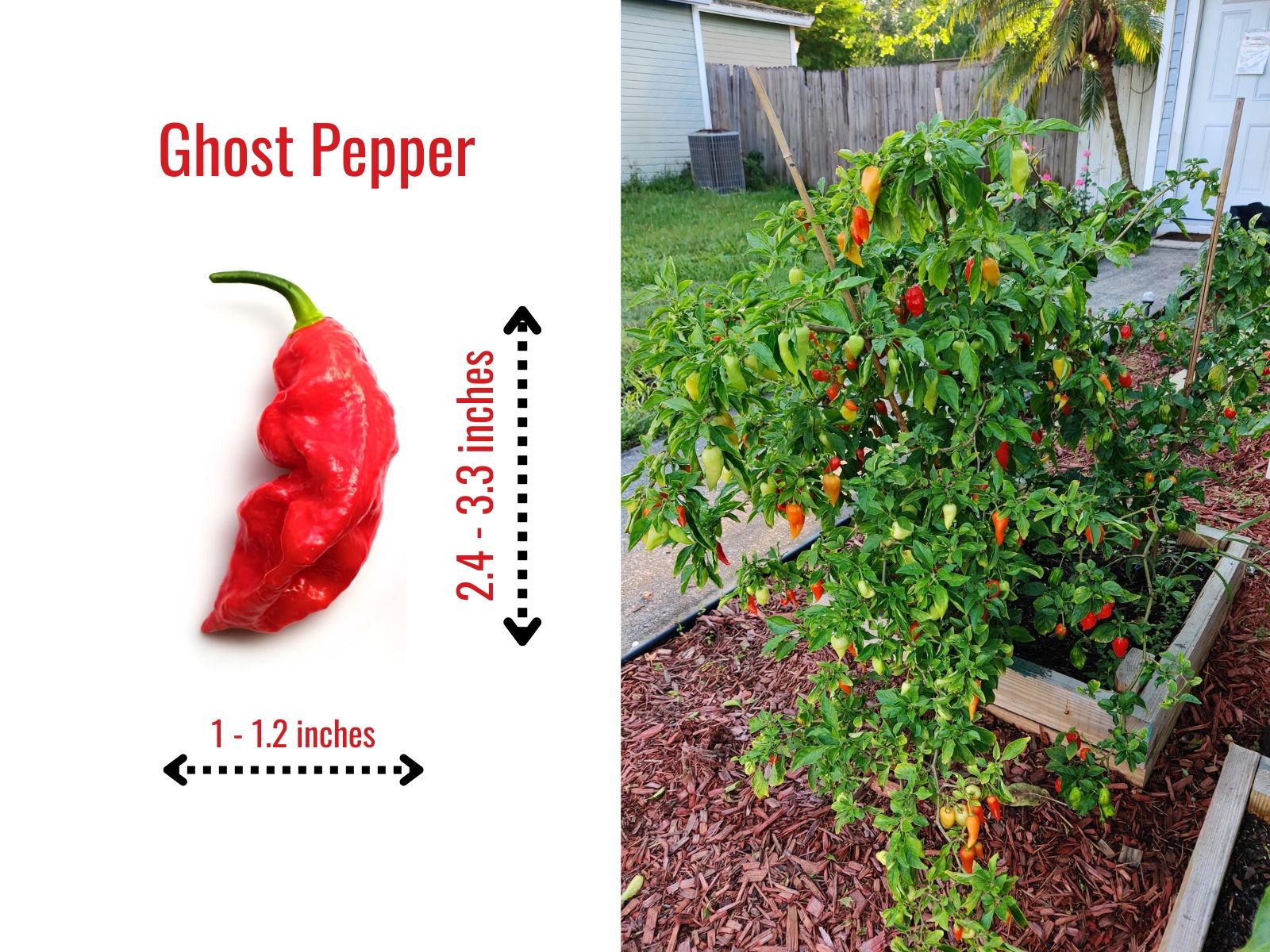
The name “ghost pepper” developed from the regional name Bhut Jolokia, while other names include Naga Jolokia, Raja Mircha, and Umorok. Guinness recognized it as the world’s hottest chili in 2007 before later superhots surpassed it. The wrinkled pods measure about 2.4 to 3.3 inches (60 to 85 mm) long and usually ripen from green to red.
In the following sections, you’ll learn how ghost peppers taste, how they compare with Carolina Reapers, how to handle and cook with them safely, and how to store or substitute them.
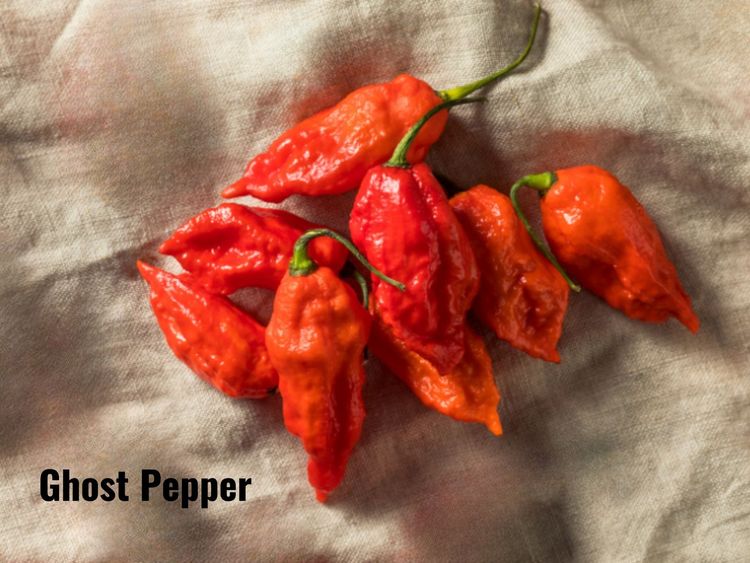
Table Of Contents
What Is a Ghost Pepper?
- How Hot Are Ghost Peppers?
How to Use Ghost Pepper in Cooking
- How to Store Ghost Pepper
- What Can You Substitute for Ghost Pepper?
What Is a Ghost Pepper?
A ghost pepper, or Bhut Jolokia, is a subconical Northeast Indian chili with thin, wrinkled skin and a tapered tip. Botanists classify it as a Capsicum chinense cultivar with evidence of genetic introgression from Capsicum frutescens. It is related to other fruity Capsicum chinense peppers, including habanero pepper and Scotch bonnet pepper, although ghost pepper reaches substantially higher heat levels.
Farmers have long grown Bhut Jolokia across Assam, Nagaland, Manipur, Arunachal Pradesh, and other parts of Northeast India. Guinness recognized it as the world’s hottest chili in 2007 before later superhot peppers surpassed it.
The name carries a linguistic mix-up. Bhut Jolokia probably derives from an Assamese expression meaning “Bhutanese pepper,” while the English name “ghost pepper” developed from a similar-sounding word for a ghost or spirit. Regional names include Bih Jolokia, Naga Jolokia, Raja Mircha, and Umorok.
A ghost pepper commonly measures 2.4 to 3.3 inches (60 to 85 mm) long and 1.0 to 1.2 inches (25 to 30 mm) wide. Each pod weighs about 0.25 to 0.32 oz (6.95 to 8.97 g). Its thin surface may appear deeply dented, rough and uneven, or relatively smooth, depending on the plant and fruit.
Ghost peppers change color as they mature:
| Color | Ripeness or Variant | Typical Flavor Character |
| Green | Unripe | Grassy, vegetal, less sweet, and already extremely hot |
| Red | Standard fully ripe form | Sweet, fruity, lightly smoky, and intensely hot |
| Yellow | Selected ripe color line | Bright, tropical, and fruit-forward |
| Orange or peach | Selected ripe color line | Citrusy, lightly floral, or mildly sweet |
| Chocolate | Selected ripe color line | Darker, earthier, and smokier |
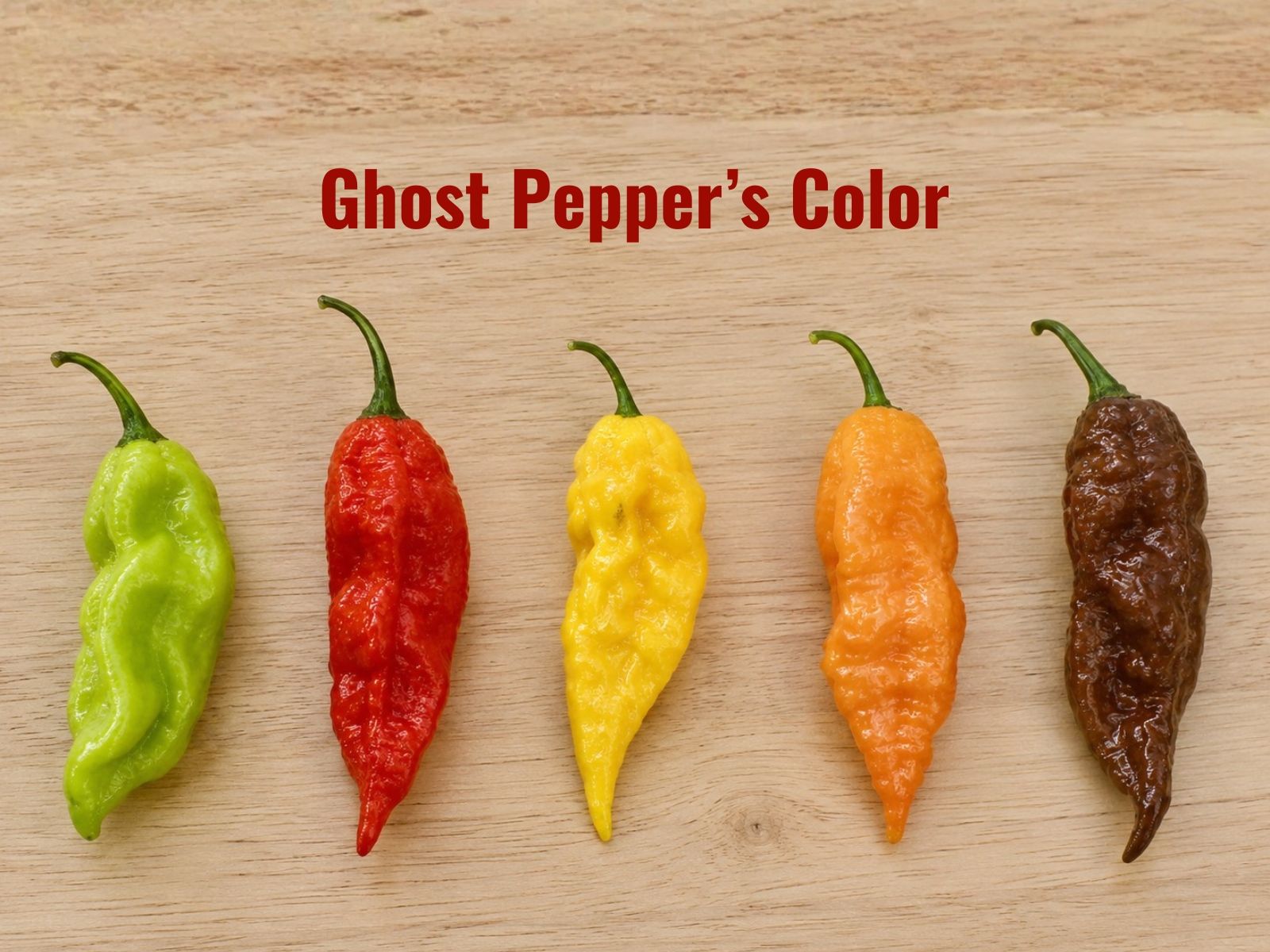
Red remains the standard and best-documented ghost pepper. Growers also offer yellow, orange, peach, chocolate, white, and purple lines, but no single testing system standardizes their heat and flavor. Color identifies the breeding line and maturity stage, not an exact SHU rating.
What Do Ghost Peppers Taste Like?
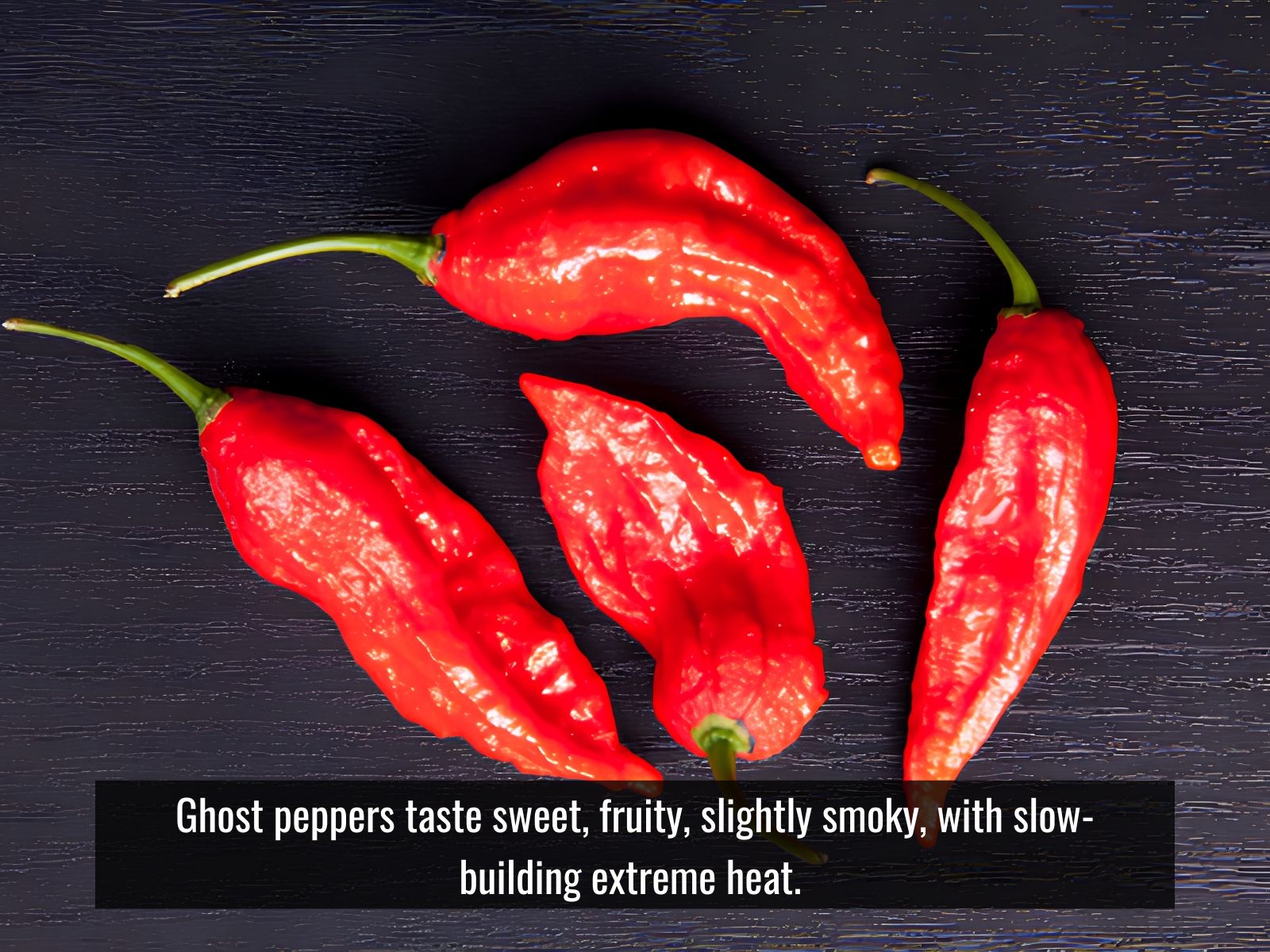
Ghost peppers taste sweet and fruity, with light smoky or earthy notes, followed by extreme heat that builds and lingers. The fruit flavor often appears first, giving Bhut Jolokia a brief sweet opening before the burn becomes dominant.
Flavor varies among color lines. Red ghost peppers provide the sweet, fruity, lightly smoky character most associated with the cultivar. Chocolate types tend to taste darker and earthier, while yellow, orange, and peach lines may show tropical, citrus-like, or floral notes. Genetics, ripeness, and growing conditions also influence the final profile.
Many eaters describe a short delay before the full heat arrives. The burn may become noticeably stronger after about 15 - 45 seconds, continue intensifying for several minutes, and remain powerful for 15 - 30 minutes or longer. This timeline serves as a sensory guide rather than a fixed rule because the amount eaten, pepper strength, surrounding food, and individual sensitivity change the experience.
Capsaicin creates the burning sensation by activating TRPV1 receptors in the mouth and digestive tract. Ghost peppers also form capsaicinoid-containing vesicles across much of the inner fruit wall, while ordinary chilies concentrate them mainly around the placental tissue. This broad distribution contributes to their exceptional overall pungency.
Small amounts work well in hot sauces, chutneys, curries, and stews, where the fruitiness spreads through the dish before the extreme heat takes over. Treat ghost pepper as a concentrated seasoning rather than a vegetable eaten by the slice.
Are Ghost Peppers Different from Carolina Reapers?
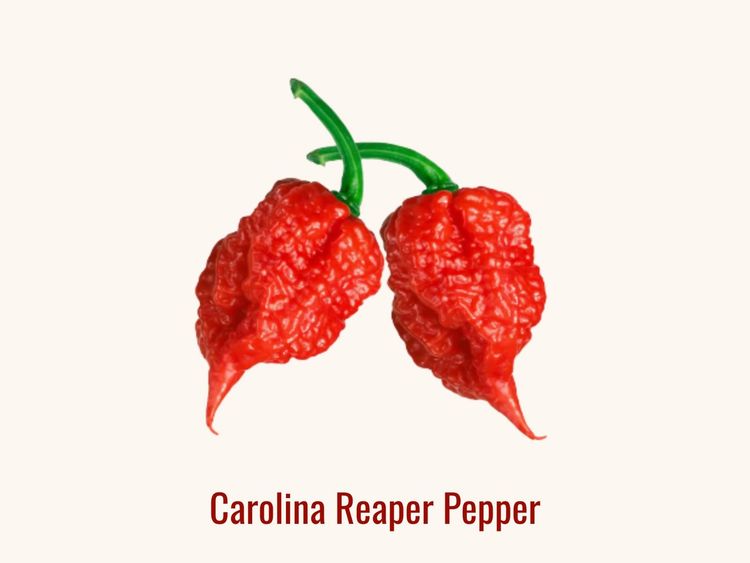
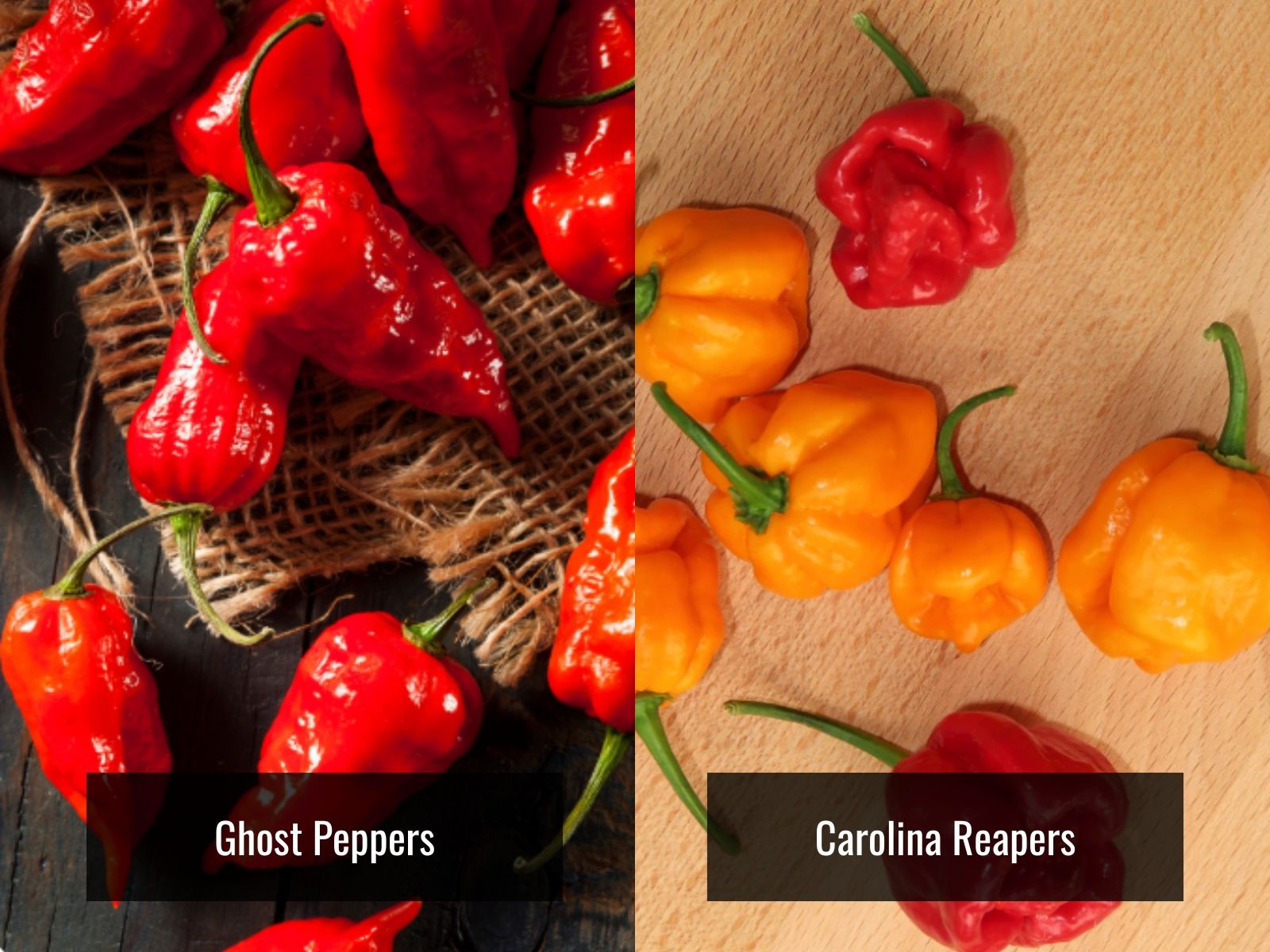
Yes. Ghost peppers and Carolina Reaper peppers are both extreme-tier superhot chilies, but the Carolina Reaper is hotter on average, more bulbous, and usually has a distinctive stinger tail. Ghost peppers are elongated, closely associated with Northeast India, and generally offer a smokier, earthier flavor.
New Mexico State University measured Bhut Jolokia at an average of 1,001,304 Scoville Heat Units (SHU), while Guinness cites a Carolina Reaper average of 1,641,183 SHU. Based on these tested benchmarks, the Carolina Reaper averages about 1.6 times the heat of a ghost pepper rather than exactly twice as hot.
| Attribute | Ghost Pepper | Carolina Reaper |
| Classification | Capsicum chinense cultivar with evidence of C. frutescens introgression | Capsicum chinense cultivar |
| Heat | Approximately 855,000 to 1,041,427 SHU | Commonly cited at approximately 1,400,000 to 2,200,000 SHU |
| Tested Benchmark | NMSU average of 1,001,304 SHU | Guinness-cited average of 1,641,183 SHU |
| Origin | Northeast India | South Carolina, United States |
| Shape | Elongated or subconical with a tapered tip | Bulbous and deeply wrinkled with a stinger tail |
| Skin | Thin, rough, and wrinkled | Rough, bumpy, and deeply wrinkled |
| Flavor | Sweet and fruity with smoky or earthy notes | Sweet and fruity with darker spice, cinnamon, or chocolate-like notes |
| Typical Heat Sensation | Often described as gradually building and lingering | Often described as sharper, faster, and more immediate |
| Best Use | Hot sauce, curry, chutney, powder, flakes, and diluted seasoning | Hot sauce, powder, flakes, and carefully diluted seasoning |
| World Record | Recognized in 2007 and surpassed in 2011 | Held the title from 2013 to 2023 |
The heat descriptions represent common sensory experiences rather than fixed timelines. The amount eaten, individual pepper strength, preparation, and personal sensitivity determine how quickly either pepper begins to burn.
Bhut Jolokia received the Guinness title in 2007 but was surpassed by the Trinidad Scorpion “Butch T” in 2011. The Carolina Reaper became the record holder in 2013 and remained so until Pepper X replaced it in 2023.
How Hot Are Ghost Peppers?
Ghost peppers measure approximately 855,000 to 1,041,427 Scoville Heat Units (SHU), placing them in the extreme tier of the Scoville scale and far above most commercially grown chilies. For comparison, pure capsaicin reaches 16,000,000 SHU, so a ghost pepper measures about 5% to 6.5% of that theoretical maximum.
The exact figure depends on the sample and testing method. India’s Defence Research Laboratory reported approximately 855,000 SHU in 2000. HPLC testing later produced the widely cited result of 1,041,427 SHU, while the Chile Pepper Institute at New Mexico State University measured New Mexico-grown pods at an average of 1,001,304 SHU. Guinness recognized Bhut Jolokia as the world’s hottest chili in 2007.
Not every ghost pepper reaches 1 million SHU. Genetics, temperature, sunlight, water availability, plant stress, fruit maturity, and testing methods can all affect capsaicinoid concentration. Different color lines may also vary genetically, but color alone cannot predict an exact heat level. Yellow, chocolate, peach, and other variants require reliable laboratory testing before a specific SHU rating can be assigned to them.
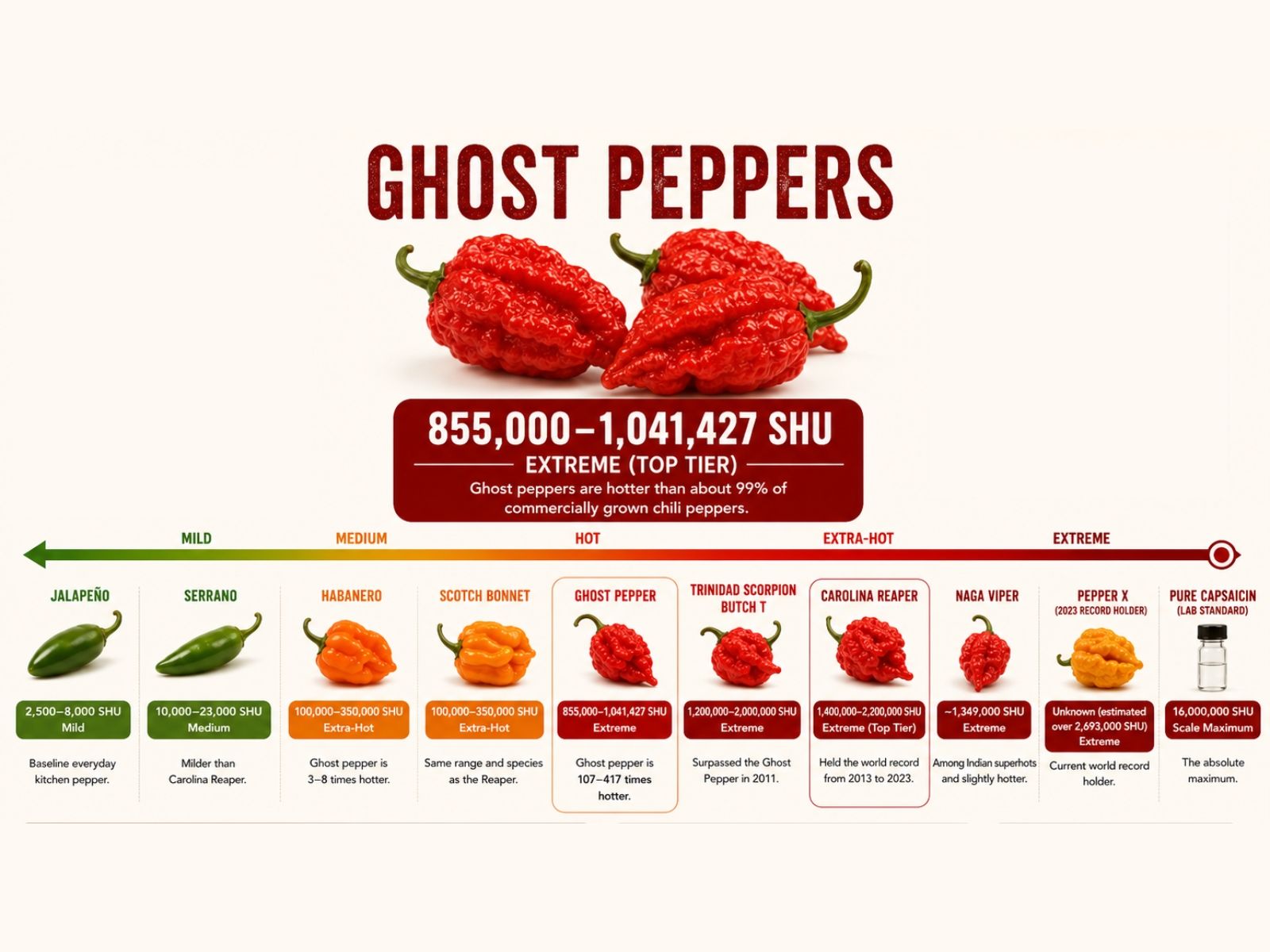
Ghost pepper ranks among the hottest chilies in the world:
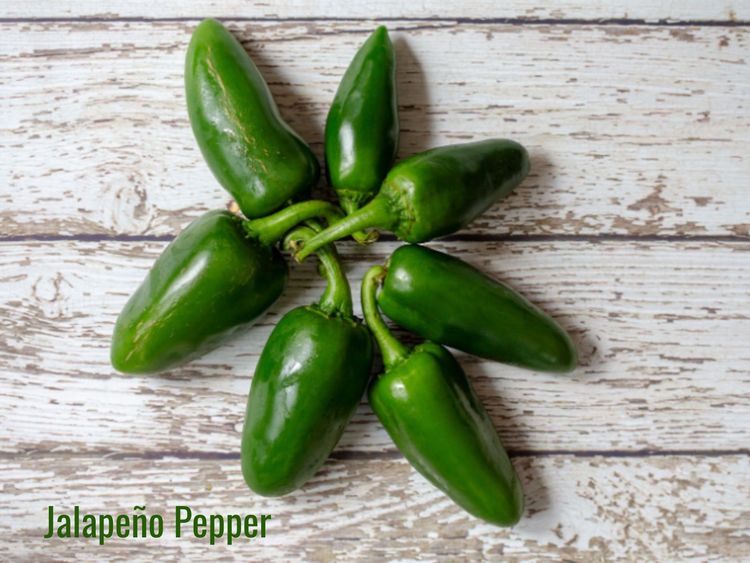
- Jalapeño pepper: Measures 2,500 to 8,000 SHU. Ghost pepper can be approximately 107 to 417 times hotter.
- Habanero pepper: Measures 100,000 to 350,000 SHU. Ghost pepper can be about 2.4 to 10 times hotter.
- Carolina Reaper: Measures about 1,400,000 to 2,200,000 SHU, making it generally hotter than ghost pepper.
- Other superhot peppers: Naga Morich, Trinidad Scorpion, and Naga Viper also belong to the extreme heat tier.
The ghost pepper’s world-record run eventually ended. The Trinidad Scorpion “Butch T” surpassed it in 2011, followed by the Carolina Reaper in 2013 and Pepper X in 2023. Pepper X currently holds the Guinness World Record with a tested average of 2,693,000 SHU.
How to Use Ghost Pepper in Cooking
Use ghost peppers in hot sauces, salsa, curries, stews, chutneys, marinades, dried seasonings, pickles, and pepper jelly. Because one pod can heat an entire batch, treat ghost pepper as a concentrated seasoning and add it gradually rather than eating it by the slice.
The nutrition is a modest bonus. A 1-teaspoon (5 g) reference portion contains so few calories, fat, carbohydrates, and protein that some values may round to zero on a Nutrition Facts label. Analyses of Bhut Jolokia genotypes have found approximately 92.07 to 301.11 mg of vitamin C per 100 g, equal to about 4.6 to 15.1 mg in 5 g, or roughly 5% to 17% of the 90 mg Daily Value. Capsaicinoids have also been studied for thermogenesis and inflammation-related effects, although normal culinary portions are too small to treat ghost pepper as a major nutrient source.
Once you understand its concentration, ghost pepper works across several reliable cooking methods:
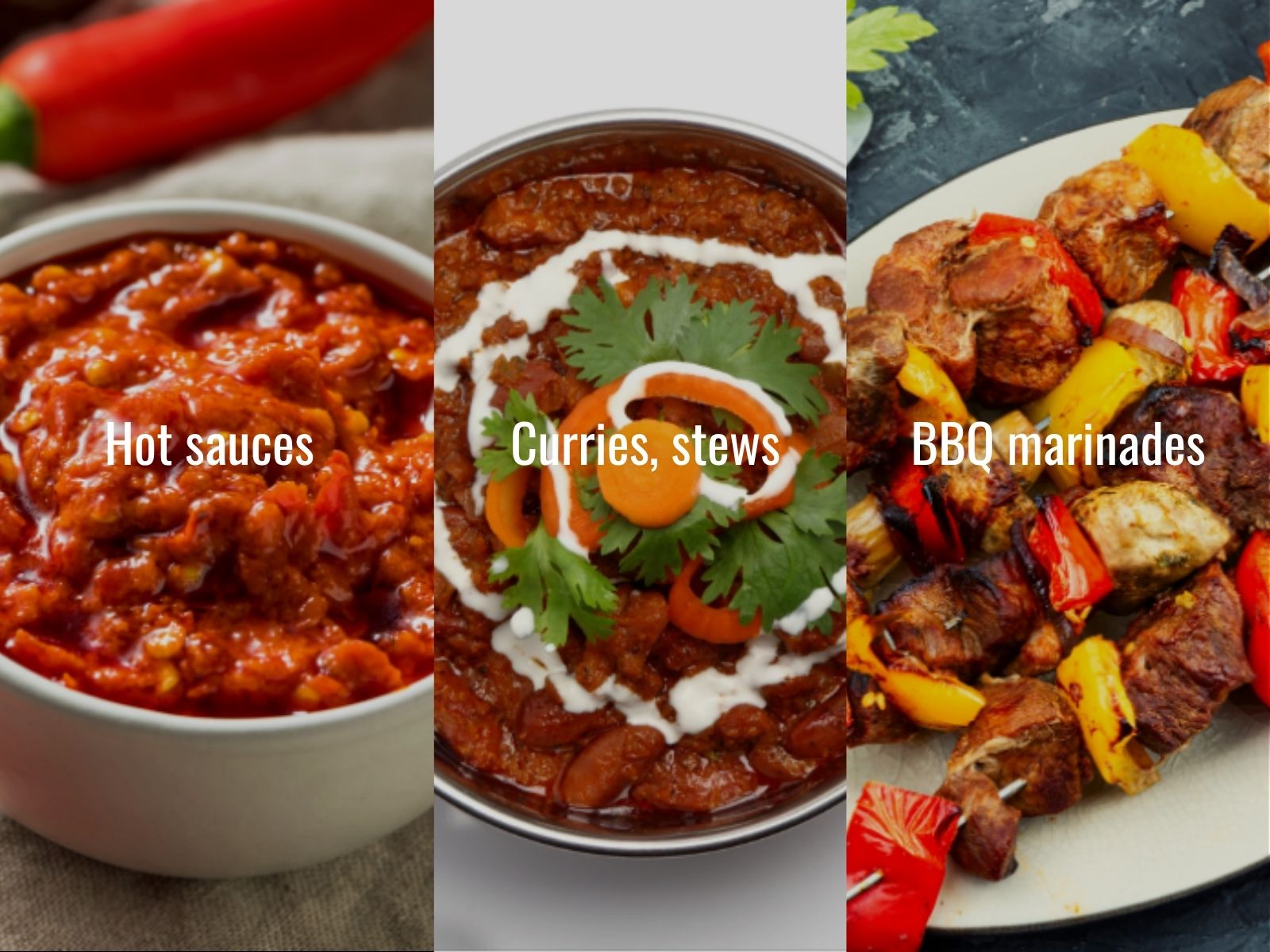
- Ghost pepper hot sauce: Blend a tiny, measured amount of ghost pepper with vinegar, tomato, garlic, onion, citrus, and salt. Mango, pineapple, peach, or berries complement its fruity flavor and distribute the heat through a larger batch.
- Curries, stews, and chutneys: In Northeast Indian cooking, small quantities flavor pork curry, fermented fish dishes, chutneys, and stews. Simmering a small intact piece and removing it before serving provides more control, while chopping or pureeing the pepper creates stronger, more evenly distributed heat.
- BBQ sauces and marinades: Combine ghost pepper with tomato, vinegar, citrus, garlic, honey, or brown sugar. Its fruitiness pairs well with pork, beef, chicken, grilled vegetables, and smoked foods. Mix thoroughly to prevent concentrated pockets of capsaicin.
- Powder, flakes, and seasoning blends: Dehydrate the pods at approximately 135 to 145°F (57 to 63°C) until completely brittle, which may take 8 to 12 hours or longer. Grind them into powder or flakes and add only a tiny pinch to chili, soup, rubs, eggs, popcorn, fries, or roasted vegetables before tasting.
- Pickled, smoked, or jellied: Ghost peppers can be preserved in vinegar brine, smoked for deeper flavor, or cooked into pepper jelly. Vinegar, fruit, and sugar complement the pepper’s sweetness but do not make it mild. Use a tested recipe for shelf-stable pickles, sauces, or jellies.
Wear nitrile or food-safe gloves whenever you handle fresh or dried ghost peppers. Avoid touching your face, eyes, nose, or contact lenses, and use strong ventilation when cutting, blending, cooking, dehydrating, grinding, or smoking them. Wash knives, cutting boards, blender jars, and work surfaces thoroughly with dish soap afterward.
If ghost pepper enters the eyes, remove contact lenses when possible and rinse with plenty of lukewarm water for at least 15 minutes. For oral burning, milk or yogurt may provide more relief than water. Seek medical help for breathing difficulty, chest pain, fainting, persistent vomiting, severe eye pain, or vision changes.
Can You Eat Ghost Pepper Every Day?
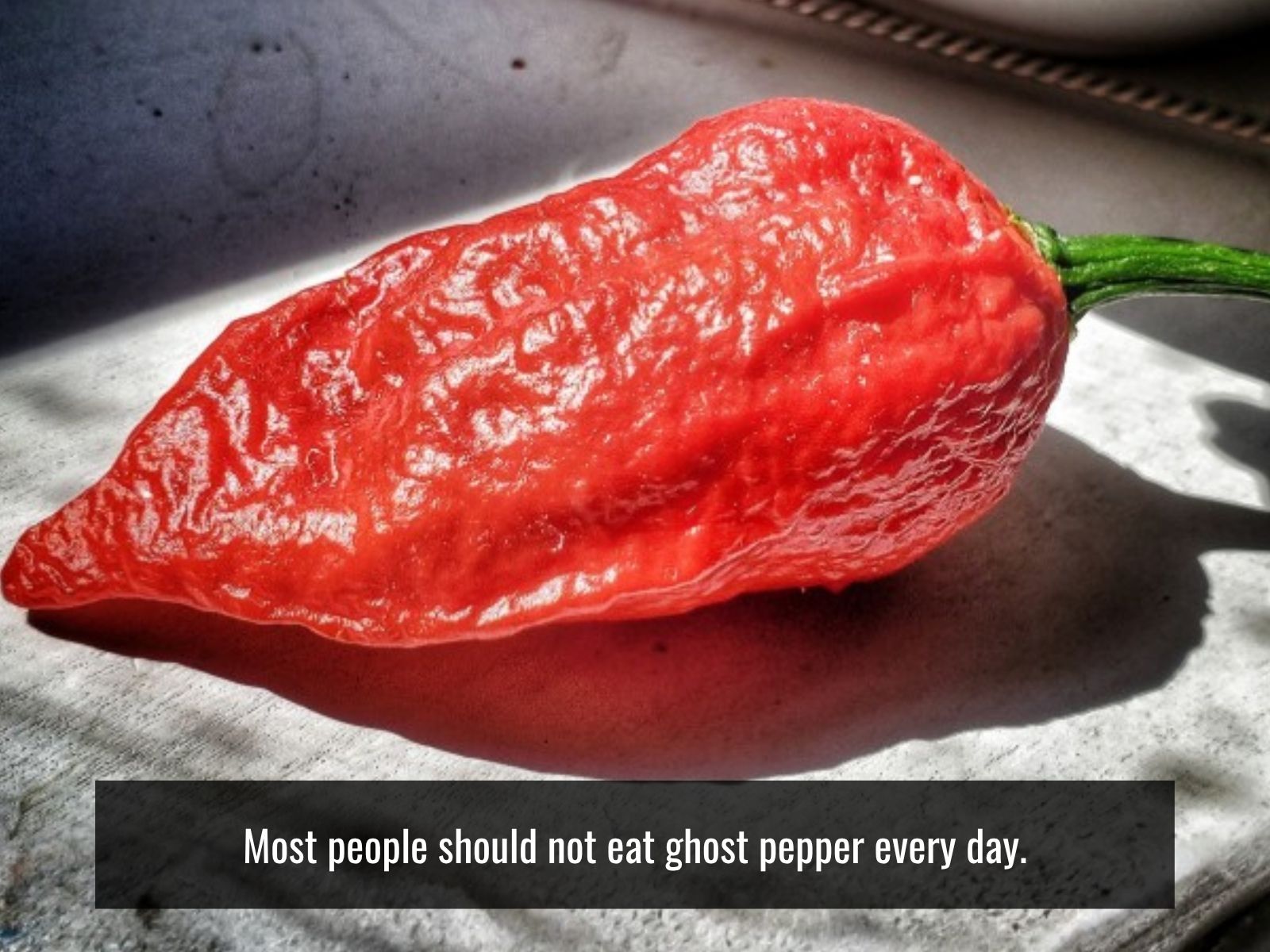
Most people should not eat a whole ghost pepper every day. Healthy adults with strong spice tolerance may use tiny amounts regularly, such as a small sliver dispersed through a large dish or a light pinch of powder. However, no universal safe daily portion has been established, and larger amounts can cause intense mouth burning, sweating, nausea, stomach cramps, vomiting, and diarrhea.
Capsaicin produces the burning sensation by activating TRPV1 receptors involved in heat and pain perception. Repeated low-dose exposure can reduce the perceived oral burn over time, but greater tolerance does not guarantee protection from stomach or intestinal discomfort.
Removing the pale placenta and inner ribs can reduce some heat, while removing the seeds alone has less effect because the seeds do not produce most of the capsaicin. Ghost peppers remain extremely pungent after trimming because superhot peppers can also accumulate capsaicinoids beyond the central placental tissue.
People with IBS, GERD, recurring heartburn, sensitive digestion, or a history of strong reactions to spicy food should avoid ghost peppers or use them only according to individual tolerance. Research has found that chili can increase abdominal pain and burning in people with diarrhea-predominant IBS, while capsaicin may trigger heartburn in susceptible individuals. Spicy food should not be described as a direct cause of gastric ulcers, although it may aggravate existing symptoms.
Serious reactions are uncommon but can occur when people consume large amounts quickly, particularly during eating challenges. One documented case involved violent vomiting followed by an esophageal rupture rather than direct tissue damage from the pepper itself. Seek urgent medical attention for chest pain, breathing difficulty, fainting, repeated vomiting, sudden severe headache, or severe abdominal pain that does not improve.
How to Store Ghost Pepper
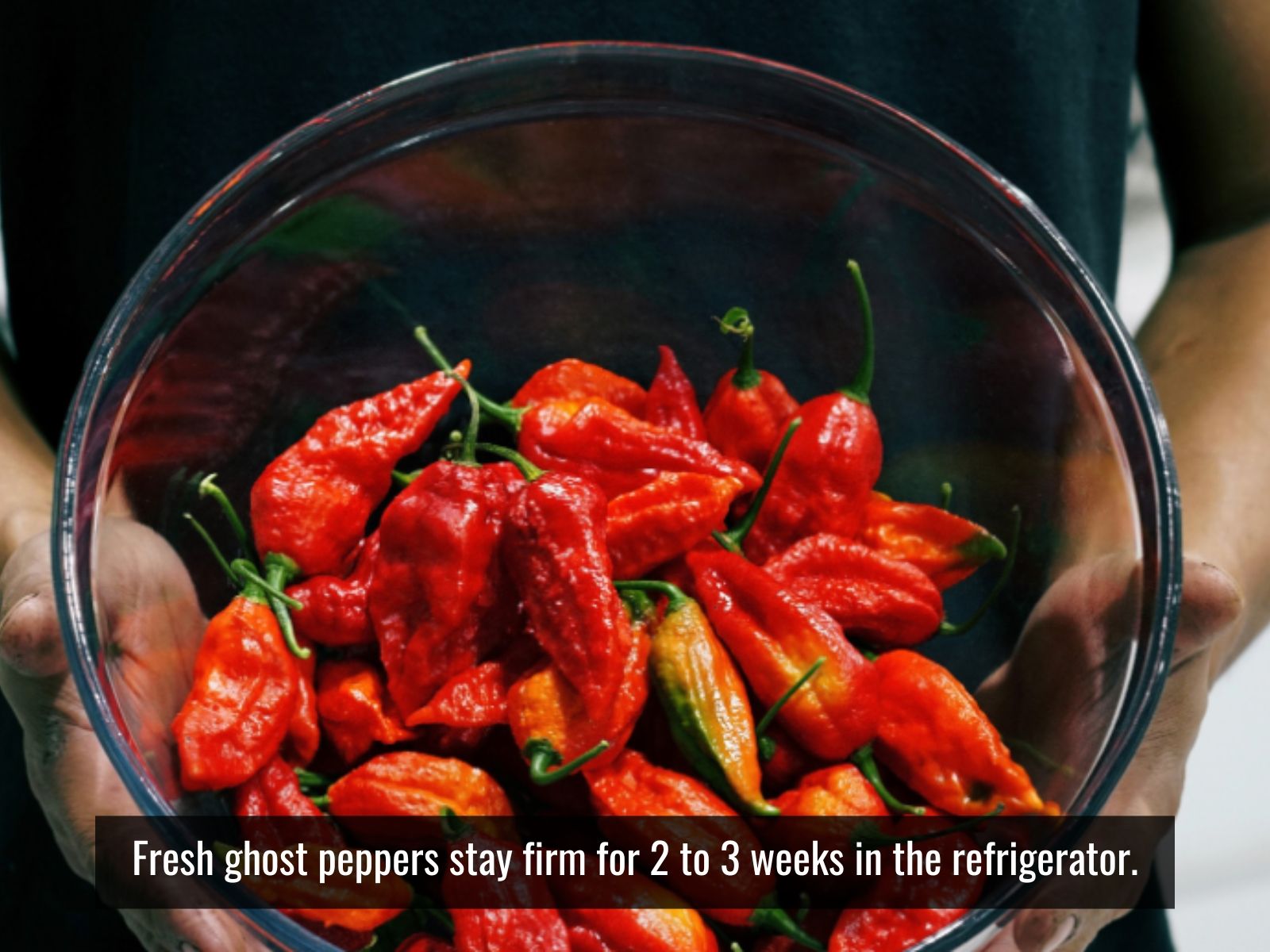
Fresh ghost peppers can remain usable for up to 2 to 3 weeks in the refrigerator, although their best-quality period depends on how fresh they were when stored. Keep them whole, dry, and unwashed in a perforated bag or breathable container. Wash them only before use, and discard any pod that develops mold, slime, leaking liquid, extensive soft spots, or an unusual odor. Prolonged cold storage may also cause surface pitting.
For longer storage, freeze the peppers whole or sliced. Wash and dry them thoroughly, arrange them in a single layer on a baking sheet, and transfer them to a freezer-safe bag after they become solid. Hot peppers do not require blanching before freezing and can retain good quality for up to 12 months at 0°F (-18°C) or below. Their texture softens after thawing, so frozen ghost peppers work best in sauces, curries, stews, and blended condiments.
Drying provides compact storage and makes the peppers easier to use as flakes or powder. Dehydrate the pods at approximately 135 to 145°F (57 to 63°C) until completely brittle. Drying may take 8 to 12 hours or longer depending on pod size, moisture, airflow, equipment, and whether the peppers are whole, slit, or sliced. Allow them to cool completely before transferring them to an airtight container in a cool, dry, and dark place.
Use dried whole peppers, flakes, or powder within approximately 4 to 12 months for the strongest flavor and aroma. Properly dried products may remain usable longer, but the original four-year quality claim is too broad because shelf life changes with temperature, moisture, light, and packaging. Discard dried peppers that develop mold, moisture, insects, or an unusual odor.
Wear gloves while preparing ghost peppers and use strong ventilation when dehydrating or grinding them. Airborne capsaicin dust can irritate the eyes and respiratory tract, so avoid leaning over the dehydrator or inhaling the powder directly. Clearly label the container and store it away from children and pets.
What Can You Substitute for Ghost Pepper?
The closest substitute for ghost pepper is habanero, used at 3 to 5 times the quantity. It shares the same fruity-sweet base but runs much milder, so you need more of it to get near ghost pepper territory. A few other peppers can fill the gap, depending on what you are cooking and how much heat you actually want.
| Substitute | Ratio | Flavor vs. Ghost Pepper | Best Used In |
| Habanero | 3–5× quantity | Similar fruity-sweet base, less smoky, much milder | Hot sauces, salsas, marinades |
| Scotch bonnet | 3–5× quantity | Bright citrus, tropical, comparable fruitiness | Caribbean-style sauces, jerk marinades |
| Ghost pepper powder | 1/4 tsp per fresh pepper | Same flavor profile, concentrated and easier to dose | Stews, chili, dry rubs, any cooked application |
| Carolina Reaper | 1/3 quantity | Hotter, cinnamon-sweet, immediate burn instead of slow build | When you want more heat, not less |
Fresh substitutes like habanero and scotch bonnet work well for sauces and fresh-cooked dishes. Ghost pepper powder is the most practical swap for any recipe that calls for fresh pepper, since the flavor profile stays identical and you can add heat by the pinch. No substitute fully replicates ghost pepper's signature slow-building burn, so treat each one as a way to get close rather than an exact match.
References
- Bosland, P.W., & Baral, J.B. (2007). "Bhut Jolokia": the world's hottest known chile pepper is a putative naturally occurring interspecific hybrid. HortScience, 42(2), 222–224.
- Chile Pepper Institute, New Mexico State University. Bhut Jolokia (Ghost Pepper) heat testing records. https://cpi.nmsu.edu
- Guinness World Records. (2007). Hottest chili pepper. https://www.guinnessworldrecords.com
- Bosland, P.W., & Votava, E.J. (2012). Peppers: Vegetable and Spice Capsicums (2nd ed.). CABI.
- Ghost pepper. (n.d.). In Wikipedia. Retrieved 2026, from https://en.wikipedia.org/wiki/Ghost_pepper
Frequently Asked Questions
A single ghost pepper is unlikely to kill a healthy adult, but it can cause severe burning, nausea, vomiting, abdominal cramps, diarrhea, skin or eye irritation, chest discomfort, and breathing problems. Serious reactions are uncommon but possible, especially after challenge-style or rapid consumption. Seek medical care when symptoms are severe or persistent.
Yes, the best-known Trinidad Scorpion peppers are generally hotter than ghost peppers. The Chile Pepper Institute lists Bhut Jolokia at approximately 1 million SHU, Trinidad Scorpion at about 1.5 million SHU, and Trinidad Moruga Scorpion at up to 2 million SHU. Exact heat varies among individual cultivars and fruits.
Yes. Ghost peppers measure approximately 855,000 to 1,041,427 SHU, while Scotch bonnet peppers commonly measure 100,000 to 350,000 SHU. Depending on the individual fruits compared, a ghost pepper can be roughly 2.5 to 10 times hotter than a Scotch bonnet.
Yes, by a substantial margin. Ghost peppers measure approximately 855,000 to 1,041,427 SHU, compared with approximately 2,500 to 8,000 SHU for jalapeños. Based on those ranges, a ghost pepper can be approximately 107 to 417 times hotter, depending on the two peppers compared.
Yes, ghost peppers are much hotter than habaneros. Ghost peppers measure 855,000 to 1,041,427 SHU, while habaneros run 100,000 to 350,000 SHU. At their hottest, ghost peppers deliver roughly 3 to 8 times the heat of a habanero. Both share a fruity flavor base, but the ghost pepper's heat builds far more slowly and lingers much longer.
Yes, ghost pepper seeds are edible. Despite the popular belief, the seeds themselves hold very little capsaicin. Most of the heat comes from the placenta, the white membrane that holds the seeds, and with ghost peppers specifically, from the fruit wall itself. Taking the seeds out does not cut the heat much with this pepper.
Fresh ghost peppers last longest when refrigerated. Store them whole and unwashed in the crisper drawer for 2 to 3 weeks. For longer storage, freeze whole peppers for 4 to 6 months, or dry them into powder that keeps for about a year in an airtight container.
Yes, ghost pepper and bhut jolokia are the same pepper. "Bhut Jolokia" is the Assamese name, and "bhut" points to "Bhutanese" (from Bhutan) rather than any spirit. Western media read "bhut" as "ghost," and the name stuck. The same pepper is also known as Naga Jolokia, Raja Mirja ("king chili"), and Bih Zôlôkia ("poison chili") in its home region.

CHIN-SU KITCHEN TEAM
CHIN-SU Kitchen Team are the creative experts behind the delicious recipes featuring CHIN-SU sauces. With years of experience and a passion for flavor, our team carefully selects recipes from a variety of trusted chefs and bloggers, bringing together the best culinary insights to present you with the most suitable and exciting dishes. Every recipe is chosen to inspire you to create meals that are not only tasty but also easy to prepare, enhancing your dining experience. Join us as we explore a wide range of sauces and flavors, and elevate every meal with the perfect recipe for your table!
User Reviews
Featured Articles
Hot Sauce Scoville Scale Explained: What Does It Mean?
What Is a Hungarian Wax Pepper? Flavor and Uses Explained
What Is an Anaheim Pepper? Flavor and Uses Explained
What Is a Serrano Pepper? Heat, Flavor and Uses Explained
What Is a Poblano Pepper? Flavor and Uses Explained
SUBSCRIBE TO GET
MORE INFO
Want the latest and greatest recipes, updates, and more from us,
straight to your inbox? Subscribe and get our NEWS!