Hot Sauce Scoville Scale Explained: What Does It Mean?
Published: Jun 14, 2026 by CHIN-SU
Updated: Jul 10, 2026 by CHIN-SU
The Scoville scale measures capsaicin concentration in chili peppers and hot sauces, recorded in Scoville Heat Units (SHU). The range stretches from 0 SHU for a bell pepper to 16,000,000 SHU for pure capsaicin. On the shelf, that means roughly 450 SHU for Frank's RedHot Hot Sauce at the mild end and 9,000,000 SHU for Mad Dog 357 Plutonium No.9 Hot Sauce at the extreme end.
Most of the time, you're standing in the hot sauce aisle, scanning labels, and there it is: a number followed by "SHU." One bottle reads 450. Another reads 135,000. A third just says "5 flames" with no number at all. What do those figures actually tell you about the heat inside?
In this article, we will covers what the Scoville scale is and who created it, how it applies to hot sauce specifically, where the most popular brands rank, where CHIN-SU products sit on the scale, and how to choose a sauce based on heat level. From there, you’ll know how spicy your hot sauce is and how to adjust your choice accordingly.
Let's start with the basics of the scale itself.
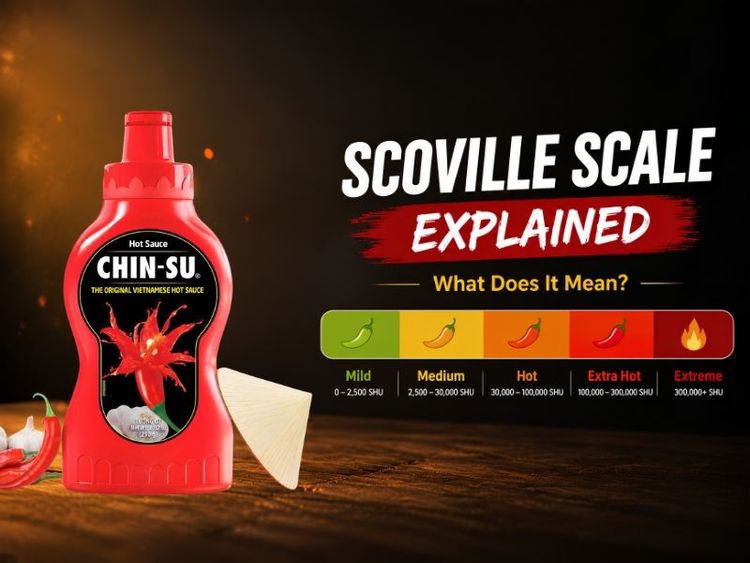
Table Of Contents
What Is the Scoville Scale?
- How Is the Scoville Scale Applied to Hot Sauce?
Popular Hot Sauce Brands Scoville Scale Rankings
How Do You Choose a Hot Sauce by Scoville Level?
What Is the Scoville Scale?
The Scoville scale measures the spiciness of chili peppers and other substances, expressed in Scoville Heat Units (SHU). It tracks the concentration of capsaicinoids, the compounds that create the burning sensation. Capsaicin is the most abundant. The higher the SHU, the hotter the pepper or sauce, with values ranging from 0 SHU (bell pepper) to 16,000,000 SHU (pure capsaicin).
Named after Wilbur Scoville, an American pharmacist who developed the Scoville Organoleptic Test in 1912, the original method relied on a sensory panel of five tasters. They would sample diluted pepper extracts until the heat was no longer detectable.
Today, the industry has moved toward more scientific methods such as High-Performance Liquid Chromatography (HPLC). This process directly measures the chemical weight of capsaicinoids, providing a more objective rating often referred to in ASTA pungency units, which are then converted back into the SHU we see on labels.
How Many Heat Tiers Are In The Scoville Scale?
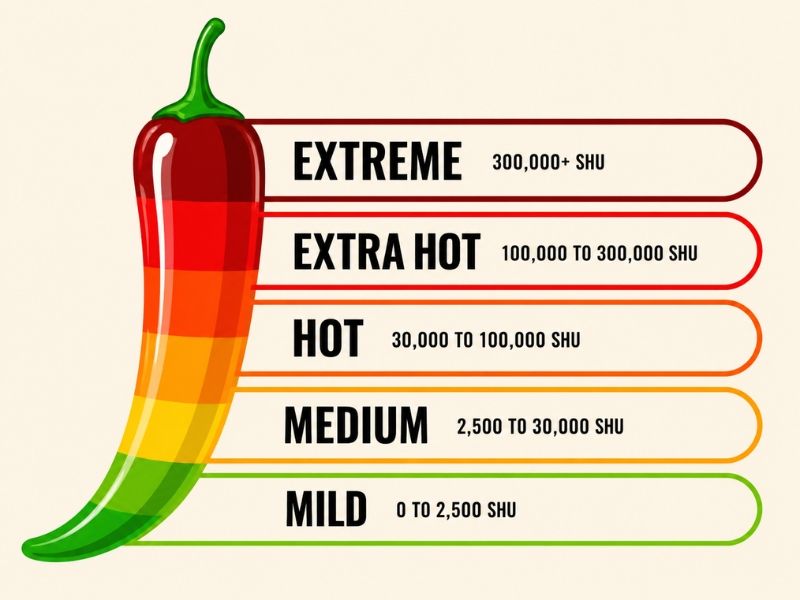
The Scoville scale breaks into five general heat tiers:
- Mild (0 to 2,500 SHU): This includes bell peppers and banana peppers. These offer no heat to gentle warmth.
- Medium (2,500 to 30,000 SHU): Features the Jalapeño (2,500 to 8,000 SHU) and serrano (10,000 to 23,000 SHU). The kick is noticeable and immediate.
- Hot (30,000 to 100,000 SHU): Includes cayenne (30,000 to 50,000 SHU) and bird's eye chili (50,000 to 100,000 SHU). These are common in many traditional Asian and Mexican dishes.
- Extra hot (100,000 to 300,000 SHU): Dominated by habanero (100,000 to 350,000 SHU), and scotch bonnet (100,000 to 350,000 SHU).
- Extreme (300,000+ SHU): Ghost pepper (855,000 to 1,041,000 SHU), Carolina Reaper (1,400,000 to 2,200,000 SHU), and Pepper X (2,693,000 SHU, Guinness confirmed). Peppers that demand serious respect.
Scoville Scale of All Peppers
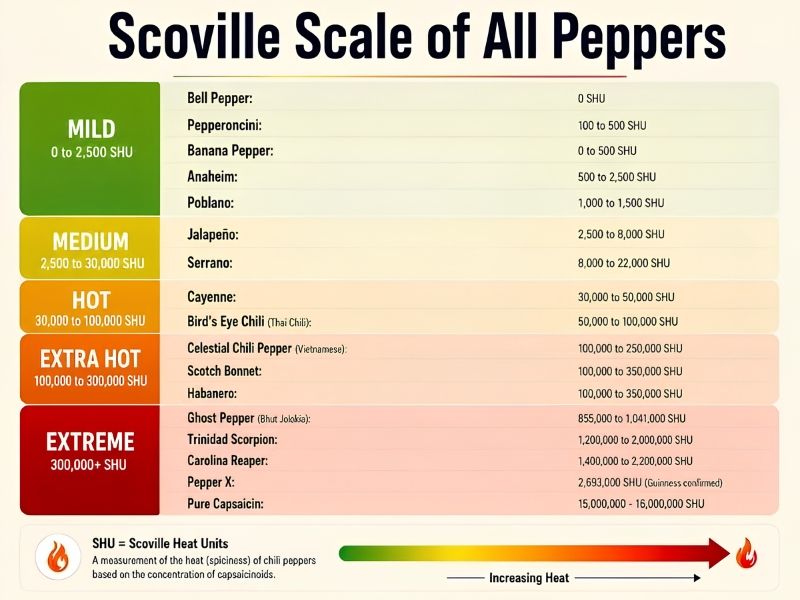
Here's a full reference list of 17 popular peppers arranged from mildest to hottest:
- Bell Pepper: 0 SHU
- Pepperoncini: 100 to 500 SHU
- Banana Pepper: 0 to 500 SHU
- Anaheim: 500 to 2,500 SHU
- Poblano: 1,000 to 1,500 SHU
- Jalapeño: 2,500 to 8,000 SHU
- Serrano: 8,000 to 22,000 SHU
- Cayenne: 30,000 to 50,000 SHU
- Bird's Eye Chili (Thai Chili): 50,000 to 100,000 SHU
- Celestial Chili Pepper (Vietnamese): 100,000 to 250,000 SHU
- Scotch Bonnet: 100,000 to 350,000 SHU
- Habanero: 100,000 to 350,000 SHU
- Ghost Pepper (Bhut Jolokia): 855,000 to 1,041,000 SHU
- Trinidad Scorpion: 1,200,000 to 2,000,000 SHU
- Carolina Reaper: 1,400,000 to 2,200,000 SHU
- Pepper X: 2,693,000 SHU (Guinness confirmed)
- Pure Capsaicin: 15,000,000 - 16,000,000 SHU
How Is the Scoville Scale Applied to Hot Sauce?
The Scoville scale measures the heat level of hot sauces by quantifying the amount of capsaicin they contain. The higher the SHU rating, the spicier the hot sauce. A sauce's final SHU almost always falls below the raw SHU of its base pepper, because other ingredients in hot sauce dilute the capsaicin concentration. For example, fresh jalapeños range from 2,500–8,000 SHU, while jalapeño-based sauces typically drop to 500–3,000 SHU after dilution with vinegar, water, and other ingredients.
Pepper SHU refers to the capsaicin concentration of the raw pepper at harvest. Sauce SHU refers to the capsaicin concentration of the finished product after all ingredients are blended. The gap can be wide: a habanero ranges from 100,000 to 577,000 SHU raw, but a habanero hot sauce with heavy fruit and vinegar dilution may test at 5,000 to 50,000 SHU.
Most hot sauce makers don't lab-test their finished sauce for SHU. They estimate the rating based on the peppers used and their concentration in the recipe. Only challenge-grade sauces (Da Bomb, Mad Dog, The Last Dab) invest in HPLC testing. For example, Heatonist uses a proprietary 1-to-10 scale, and HotSauce uses a 1-to-5 flame rating.
When you are scanning labels in the supermarket, you should treat the pepper name primarily as a flavor profile indicator. The Scoville Heat Units or the brand's specific heat scale are the only true measures of the actual burning sensation you will experience when consuming the sauce.
Popular Hot Sauce Brands Scoville Scale Rankings
When you stand in the hot sauce aisle, the SHU number tells the real story of the heat inside. A sauce's final SHU almost always falls below the raw SHU of its base pepper because ingredients like vinegar, water, and sugar dilute the concentration.
The table below ranks 26 popular hot sauces from mildest to hottest:
| Brand / Sauce | Primary Pepper | SHU Range | Heat Level Tier |
| Texas Pete Original | Cayenne | 340 - 740 | Mild |
| Frank's RedHot Original | Aged cayenne | approximately 450 | Mild |
| Valentina (Red Label) | Chili puya | approximately 900 | Mild |
| Louisiana Hot Sauce Original | Cayenne | 1,000 to 2,000 | Mild |
| Sriracha (Huy Fong) | Red jalapeño | 1,000 to 2,500 | Mild |
| Cholula Original | Arbol + piquín | 1,000 to 2,500 | Mild |
| CHIN-SU Sriracha | Celestial Chili Pepper | 1,500 to 2,000 | Mild |
| CHIN-SU Hot Sauce | Celestial Chili Pepper | 1,500 to 2,000 | Mild |
| Crystal Hot Sauce | Cayenne | 2,000 to 4,000 | Mild to Medium |
| Tabasco Original | Tabasco pepper | 2,500 to 5,000 | Medium |
| Tapatio | Red jalapeño peppers | approximately 3,000 | Medium |
| El Yucateco Red Habanero | Habanero | 7,600 to 9,500 | Medium |
| Secret Aardvark | Habanero + tomato | 15,000 | Medium |
| Bravado Ghost Pepper & Blueberry | Ghost pepper | 50,000 to 250,000 | Hot to Extra Hot |
| Dawson's Original | Habanero | approximately 82,000 | Hot |
| Bunsters Black Label | Bird's eye + scorpion | approximately 99,000 | Hot |
| Da Bomb Beyond Insanity | Habanero + extract | approximately 135,000 | Extra Hot |
| Dave's Insanity | Habanero + extract | 180,000 | Extra Hot |
| Dingo Widow Maker | 6 superhot varieties | approximately 682,000 | Extreme |
| Satan's Blood | Pepper extract | approximately 800,000 | Extreme |
| Mad Dog 357 Gold | Habanero + extract | approximately 1,000,000 | Extreme |
| Dragon In The Clouds | Ghost pepper + yuzu | approximately 1,000,000 | Extreme |
| DA BOMB The Final Answer | Extract blend | approximately 1,500,000 | Extreme |
| The Last Dab Triple X | Pepper X | 2,000,000 Pus | Extreme |
| The Source | Pepper extract | approximately 7,100,000 | Extreme |
| Mad Dog 357 Plutonium No.9 | Capsaicin extract | approximately 9,000,000 | Extreme |
Mild and medium hot sauces dominate shelf space because they pair well with everyday meals without overpowering food. In the U.S. hot sauce market which reached over 4.5 billion dollars in annual sales in 2025, sauces under 10,000 SHU account for the majority of retail volume as common condiments used on foods like eggs, rice, pizza, and sandwiches.
Most American tabletop hot sauces varieties (Frank's, Tabasco, Cholula, Louisiana) use cayenne or tabasco peppers that end up at under 5,000 SHU in the finished sauce.
CHIN-SU hot sauce also falls within this mild range at about 1,500 to 2,000 SHU in its finished form, even though it is made from celestial chili peppers rated at 100,000 to 250,000 SHU on the Scoville scale. Since charcoal grilling and fermented garlic processing tame the raw heat into a rounder, more layered flavor, CHIN-SU stays in the mild territory where everyday cooking feels comfortable.
Scoville Ranking of All CHIN-SU Hot Sauce Products
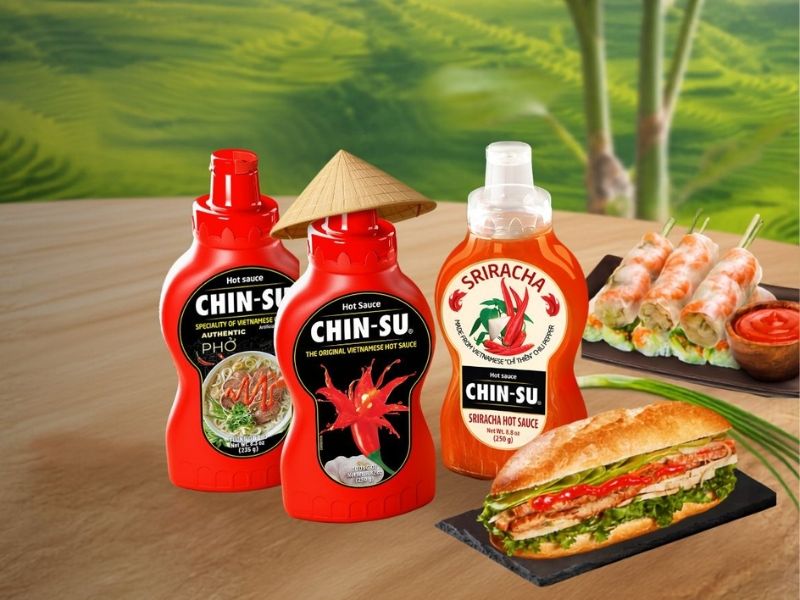
CHIN-SU produces a lineup of three distinct hot sauce varieties, all of which feature the Celestial chili pepper, known in Vietnam as ớt chỉ thiên, as the primary ingredient. This specific chili variety is native to the mountainous provinces of Northern Vietnam, where it thrives in a lush and tropical climate. The pepper is recognized for its elongated shape and bright red color. On the Scoville scale, the raw Celestial chili measures between 100,000 to 250,000 SHU, which classifies it as one of the spicier peppers in Vietnamese cooking.
Even though the raw material is intense, the finished CHIN-SU products are carefully designed for accessibility and culinary balance. All three major varieties fall within the 1,500 to 2,000 SHU range on the Scoville scale. This positioning allows the sauces to provide a consistent kick without overpowering the other ingredients in a dish.
- CHIN-SU Hot Sauce is the flagship. It's made from charcoal-grilled celestial chili pepper blended with fermented garlic on a vinegar base. It falls in the medium-hot range at 1,500 to 2,000 SHU.
- CHIN-SU Sriracha Chili Sauce uses the same celestial chili pepper base in a sriracha-style format with a thicker consistency. It falls within the medium range, at 1,500 to 2,000 SHU.
- CHIN-SU Sriracha Chili Sauce for Pho is formulated for Vietnamese pho and features a flavor profile tuned for broth-based dishes. It falls within the medium range, at 1,500 to 2,000 SHU.
How Do You Choose a Hot Sauce by Scoville Level?
Selecting the right bottle depends on your personal heat tolerance and how you intend to use the sauce in your daily meals. For a seamless culinary experience, it is best to match the sauce's SHU range to your specific eating habits.
Many daily hot sauce users gravitate toward the medium tier, which typically ranges from 1,000 to 5,000 SHU. This range is often considered the sweet spot for heat because these sauces add a noticeable kick without masking the delicate flavors of the food. Popular choices like Sriracha, Cholula, and Tabasco all operate within this zone. For fans of Southeast Asian cuisine, sauces built on the Celestial chili pepper like CHIN-SU offer a sophisticated step up, providing a layered warmth that suits the complex profiles of Pho, stir-fries, and rice plates.
It is a well-known fact among "chiliheads" that heat tolerance does not stay fixed. With consistent exposure, your TRPV1 receptors become less sensitive to the burn, allowing you to enjoy hotter sauces over time. A practical rule for building spice tolerance is to move up the scale one tier at a time. If your current sauce at 2,000 SHU no longer provides a satisfying kick, look for a product in the next range rather than jumping directly to an extreme extract. Jumping too many tiers at once often leads to an unpleasant experience rather than a flavorful one.
The type of dish you are preparing should also dictate the Scoville level you choose. Matching the intensity of the sauce to the density of the food ensures a balanced meal:
- Mild Sauces (0 to 2,500 SHU): These are ideal for breakfast eggs, grilled cheese sandwiches, and meals for children where flavor is more important than fire.
- Medium Sauces (2,500 to 30,000 SHU): This is the most versatile range, suitable for tacos, pizza, chicken wings, and noodle soups.
- Hot Sauces (30,000 to 100,000 SHU): These are best utilized as a cooking foundation. Adding them to marinades, stews, or a large pot of chili allows the heat to distribute through cooking evenly.
- Extra Hot and Extreme Sauces (300,000 plus SHU): These products demand serious respect. They are typically used for spicy challenges or added one drop at a time to an entire dish. Products at this level require careful handling and often function more as food additives than standard condiments.
Does a Higher Scoville Number Always Mean a Better Hot Sauce?
No. A higher Scoville number measures more capsaicin, but it doesn't measure flavor, balance, or how well a sauce pairs with food. Those factors are often just as important when choosing a hot sauce as its heat level.
SHU is a single-axis measurement. It tracks capsaicin concentration only. The sauces rated highest on the Scoville scale, such as The Source at 7,000,000 SHU and Mad Dog Plutonium at 9,000,000 SHU, are sold as food additives rather than condiments. They're too concentrated to eat directly.
The most popular sauces in the US all sit under 5,000 SHU because they balance heat with flavor depth. Extract-based sauces often produce a metallic, bitter taste that pepper-based sauces at the same SHU don't carry. Heat without flavor is a novelty. Heat with flavor is a condiment you'll use every day.
Is the Scoville Scale the Same as the "Hot Sauce Heat Scale" Listed on Bottles?
Not exactly. The Scoville scale measures capsaicin in SHU, while the heat scales printed on most bottles (1 to 5 flames, 1 to 10 ratings) are simplified brand-specific systems.
For example, HotSauce uses a 1-to-5 flame system, while Heatonist uses a proprietary 1-to-10 scale. These systems show roughly where a sauce falls relative to other sauces in that brand's lineup, but the numbers don't convert directly to SHU. A "3 out of 5 flames" from one brand might equal 5,000 SHU, while another brand's "3 out of 5" might equal 50,000 SHU. When you're comparing heat across different brands, SHU is the only common denominator. If a bottle only shows flames or a number scale with no SHU listed, check the pepper type and search for that pepper's typical range on the Scoville scale.
Now you know the full picture. The Scoville scale ranges from 0 SHU (bell pepper) to 16,000,000 SHU (pure capsaicin), and most of the hot sauces you actually reach for at dinner fall between 450 and 5,000 SHU. That mild-to-medium range is where flavor and heat coexist without one overpowering the other. CHIN-SU chili sauce lands at 1,500 to 2,000 SHU, built on celestial chili, charcoal-grilled heat, and fermented garlic depth. It's the kind of sauce you can put on eggs in the morning, stir into noodle soup at lunch, and drizzle over grilled chicken at dinner without ever reaching for a glass of milk. Find CHIN-SU at chinsu.com.
Frequently Asked Questions
The average commercial hot sauce sold in the US ranges from 1,000 to 5,000 SHU. This range covers the medium tier, which includes sauces like Tabasco (2,500 to 5,000 SHU), Cholula (3,600 SHU), Sriracha (1,000 to 2,500 SHU), and CHIN-SU Chili Sauce (1,500 to 2,000 SHU). The median falls between 2,500 and 3,000 SHU because most retail sauces prioritize everyday usability over extreme heat resistance.
Water doesn't reduce capsaicin burn. Capsaicin is an oil-based molecule that doesn't dissolve in water. Drinking water can spread the compound throughout your mouth, worsening the burning sensation. Dairy products like milk, yogurt, and sour cream work because casein, a protein in dairy, binds to capsaicin and lifts it off TRPV1 receptors. Bread, rice, and sugar also help absorb and dilute capsaicin.
Cooking reduces capsaicin, but doesn't eliminate it. At boiling temperature (212°F / 100°C) for 90 minutes, capsaicinoid content drops by roughly 30%, according to Si et al. (2014) in Natural Product Communications. Degradation begins at 149°F (65°C), so the longer you cook, the more heat you lose. Pairing with fat softens the burn further by dissolving capsaicin across the palate rather than letting it concentrate in one spot.
The Scoville scale measures capsaicin concentration, and that concentration doesn't change during fermentation, so the measured SHU of a fermented sauce is technically accurate. The complication is that fermentation changes perceived heat. Lacto-fermentation lowers the sauce's pH, altering how capsaicin interacts with taste receptors. A fermented sauce at 5,000 SHU often feels milder than a non-fermented sauce at the same 5,000 SHU. The acidic environment and complex flavor compounds produced by Lactobacillus bacteria soften the burning sensation on the tongue.
Technically, no. The Scoville scale specifically measures capsaicin, the oily compound found in peppers. Wasabi and ginger get their heat from isothiocyanates, which affect the nasal passages rather than the tongue receptors. Therefore, wasabi does not have an official SHU rating.

CHIN-SU KITCHEN TEAM
CHIN-SU Kitchen Team are the creative experts behind the delicious recipes featuring CHIN-SU sauces. With years of experience and a passion for flavor, our team carefully selects recipes from a variety of trusted chefs and bloggers, bringing together the best culinary insights to present you with the most suitable and exciting dishes. Every recipe is chosen to inspire you to create meals that are not only tasty but also easy to prepare, enhancing your dining experience. Join us as we explore a wide range of sauces and flavors, and elevate every meal with the perfect recipe for your table!
User Reviews
Featured Articles
SUBSCRIBE TO GET
MORE INFO
Want the latest and greatest recipes, updates, and more from us,
straight to your inbox? Subscribe and get our NEWS!