Phở Bò Recipe - Vietnamese Beef Noodle Soup
Published: Jul 28, 2026 by CHIN-SU
Updated: Jul 28, 2026 by CHIN-SU
Tested by CHIN-SU Kitchen Team
Beef pho (phở bò) is Vietnam's national dish and has become one of its most popular dishes worldwide. This soup comes from northern Vietnam, where people first boiled beef bones down to make a clear, great-smelling broth. That broth is really the best part. It tastes light and fresh but is packed with the flavors of star anise, cinnamon, and roasted ginger. You just pour it over flat rice noodles, sliced beef, and a side of fresh herbs.
Whether you grew up eating phở and now live far from a good noodle shop or simply want authentic Vietnamese food at home without restaurant prices, you can make phở bò from scratch. Today, CHIN-SU shares the complete recipe, practical tips for keeping the broth clear and flavorful, and the traditional Vietnamese way to serve it. The process takes 7 to 8 hours, but the bones simmer unattended for most of that time. Active preparation takes about 45 minutes, and one batch makes 6 to 8 bowls.
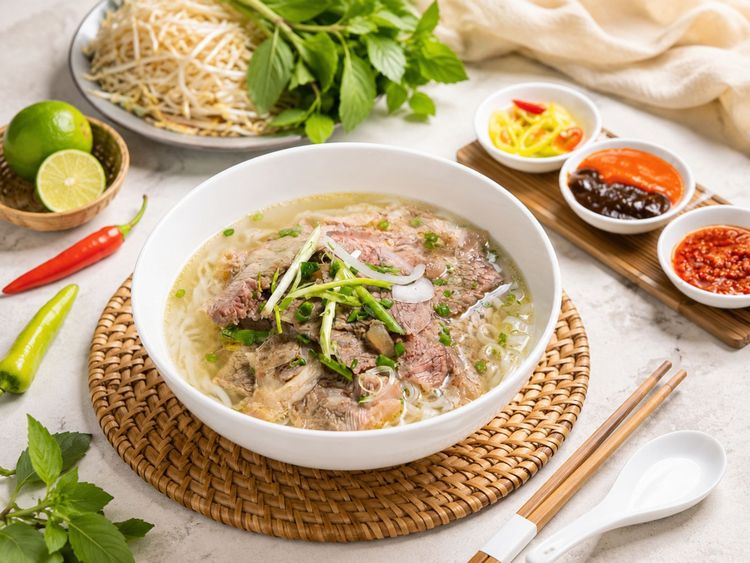
Table Of Contents
- What Is Beef Pho?
- Why You'll Love Beef Pho
- Beef Pho Ingredients
How to Make Beef Pho Step by Step
- Step 1: Soak the Beef Marrow Bones
- Step 2: Wash the Brisket and Beef Muscle
- Step 3: Blanch the Bones
- Step 4: Blanch the Brisket and Beef Muscle
- Step 5: Start the Bone Broth
- Step 6: Skim and Reduce to a Low Simmer
- Step 7: Boil the Brisket and Beef Muscle
- Step 8: Cool the Cooked Beef in Ice Water
- Step 9: Dry-Toast the Spices
- Step 10: Soak the Spice Sachet
- Step 11: Roast the Onion and Ginger
- Step 12: Add the Roasted Aromatics to the Broth
- Step 13: Add the Spice Sachet to the Broth
- Step 14: Remove Aromatics, Spices, and Bones
- Step 15: Season the Broth
- Step 16: Slice the Cooked Beef
- Step 17: Slice the Raw Beef for Tái
- Step 18: Prep the Herb Plate and Garnishes
- Step 19: Blanch the Rice Noodles
- Step 20: Assemble the Bowl
How to Serve Beef Pho
- Tips for the Best Beef Pho
- What Can You Substitute or Change in Beef Pho?
- How to Store Beef Pho?
What Is Beef Pho?
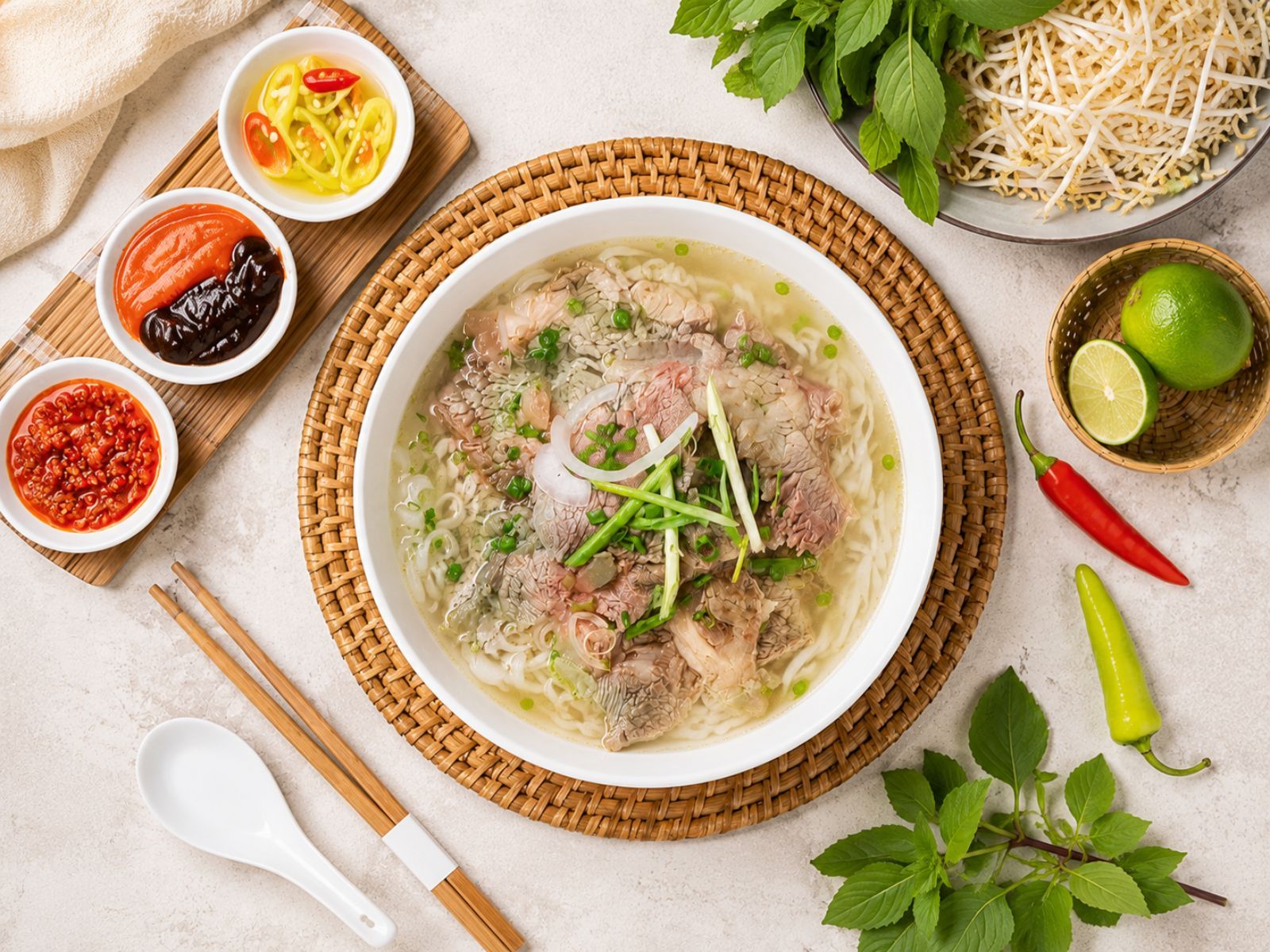
Phở bò (Beef pho - Vietnamese beef noodle soup) is a rice noodle soup made with a slow-cooked beef bone broth, flat rice noodles (bánh phở), aromatic spices, and thin slices of beef, served in a deep bowl with a plate of fresh herbs on the side. English speakers usually say it as "fuh," and the word "phở" itself just refers to the rice noodles.
Back in the early 20th century, pho originated in northern Vietnam, according to the Michelin Guide, specifically in Hanoi and Nam Dinh. Vietnamese families eat it for breakfast, lunch, or a late dinner. In the US, you will come across pho at Vietnamese restaurants and noodle shops, where the broth tastes clean and rich, with notes of star anise, cinnamon, and roasted ginger in a light yet very beefy bowl.
In Vietnam, a bowl at a well-known phở shop costs about 40,000 to 70,000 VND ($1.60 to $2.80), while the same dish typically costs $14 to $18 at a US restaurant. This price difference makes a large pot of homemade broth a practical, cost-effective option.
Why You'll Love Beef Pho
You'll love this beef pho recipe because the broth really stands out: clear, super tasty, and good enough to drink on its own.
- Huge flavor from real bones. Cooking marrow bones, roasted ginger, and toasted spices for 6 to 8 hours builds a soup you can rely on, getting a nice savory boost from fish sauce (nước mắm).
- Fix up your bowl. Add rare beef, cooked brisket, or both, then everyone finishes their own soup with the fresh herb plate and sauces.
- Mostly hands off. You only work for about 45 minutes, then the pot cooks on low heat while you just walk away.
Beef Pho Ingredients
To make this beef pho, you will put together 4 groups of ingredients: bones and beef, spices, broth seasoning, and a fresh herb-and-noodle spread for serving.
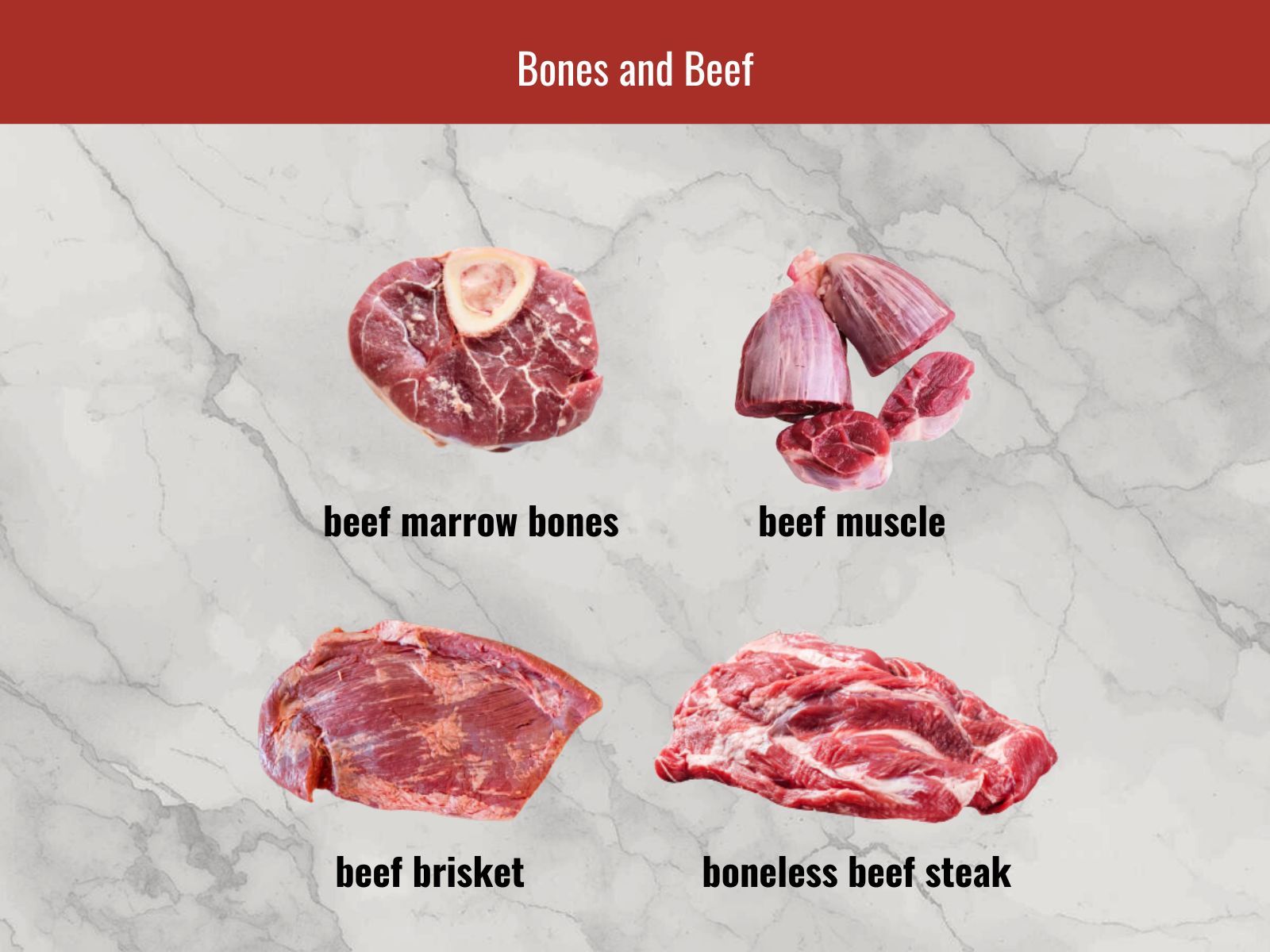
Bones and Beef
- 3.3 lb (1.5 kg) beef marrow bones (xương ống). We use fresh marrow bones whenever we can because they give a cleaner broth than frozen ones, though oxtail (xương đuôi) works fine too.
- 2.2 lb (1 kg) beef muscle (bắp bò). Beef muscle holds up well during the long boil and slices nicely once it cools.
- 1.75 lb (800 g) beef brisket (nạm bò). Brisket is what pho sellers usually go for, since it cooks for hours without falling apart. You can also toss in fatty brisket (gầu) or tendon (gân) if you like.
- 1.1 lb (500 g) boneless beef steak (bò tái). Boneless beef steak goes in raw, and the hot broth cooks the slices to medium rare right in your bowl.
None of these cuts is hard to track down. You will spot brisket and meaty soup bones at most big supermarkets, and marrow bones are super easy to find at butcher shops or in the freezer section of Asian stores.
Broth Spices and Aromatics
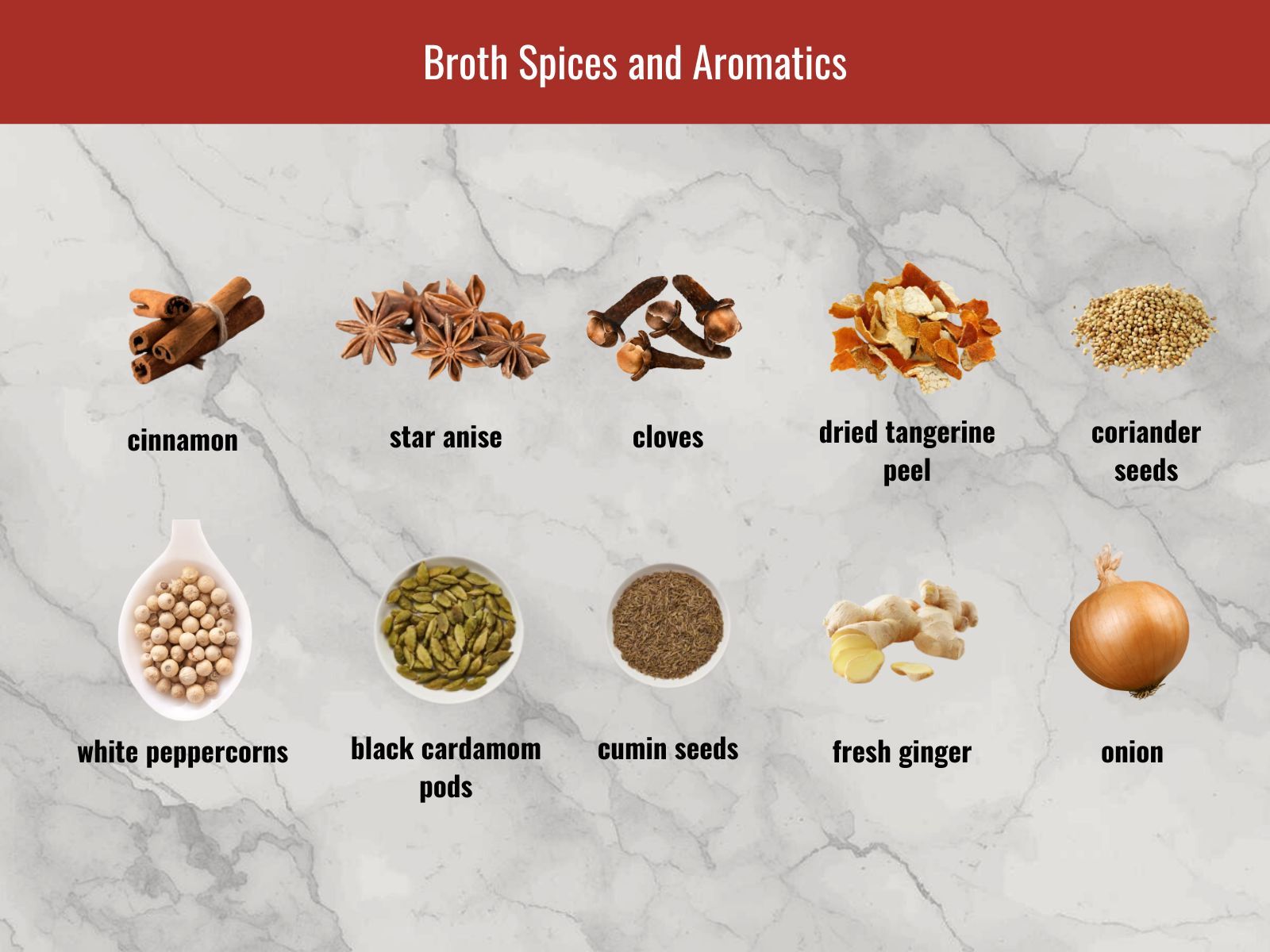
- 6 g cinnamon (quế)
- 3 whole star anise (hoa hồi)
- 7 whole cloves (đinh hương)
- 5 g dried tangerine peel (trần bì)
- 5 g coriander seeds (hạt ngò)
- 10 g white peppercorns (tiêu sọ)
- 3 black cardamom pods (thảo quả)
- 3 g cumin seeds (tiểu hồi)
- 2 oz (60 g) fresh ginger
- 1 large onion, about 14 oz (400 g)
If you want the freshest spices, check out a Chinese herb shop (tiệm thuốc Bắc), though most Asian grocery stores carry them too.
Broth Seasoning
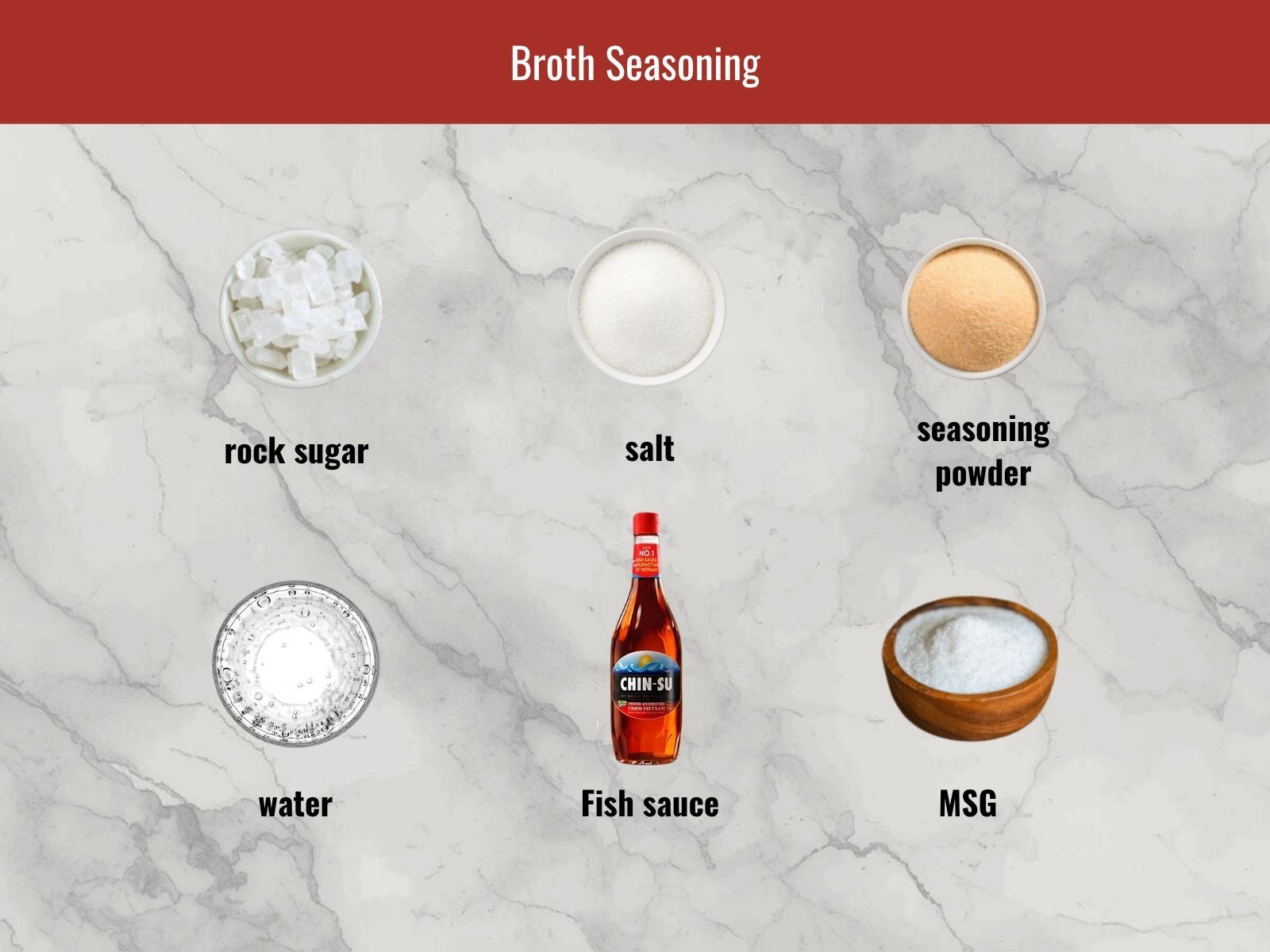
- 3 tbsp (45 g) rock sugar (đường phèn). Rock sugar gives a cleaner sweet taste than plain white sugar.
- 1.5 tbsp (22 g) salt. Salt sets up the savory base for your broth.
- 4 tbsp (48 g) seasoning powder (hạt nêm). Seasoning powder really fills out that savory flavor.
- 1 tbsp (13 g) MSG (bột ngọt). MSG pumps up the soup's rich umami taste.
- 1 gallon (4 L) of water. Water makes up the base of the soup.
- 1 to 2 tbsp fish sauce (nước mắm), to taste. Fish sauce finishes off the broth with the savory taste of salted anchovies. A good fish sauce really makes a difference, so we use CHIN-SU fish sauce for its clean anchovy flavor and just the right amount of salt.
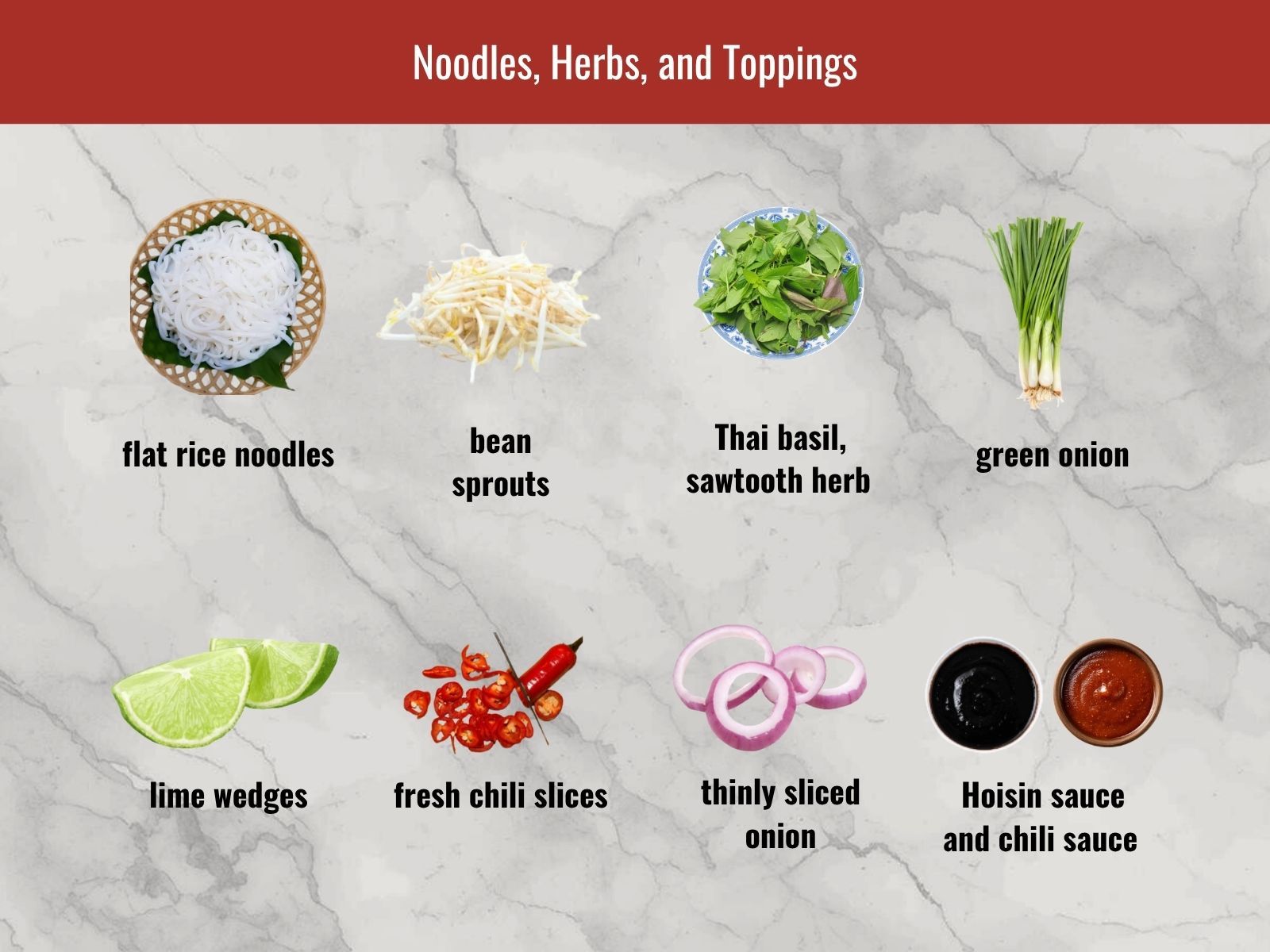
Noodles, Herbs, and Toppings
- 1.5 lb (700 g) flat rice noodles (bánh phở). Fresh flat rice noodles beat dried ones for texture, so if dried ones are all you have on hand, soak them for 20 minutes in room-temperature water before boiling them quickly.
- For the table: bean sprouts (giá đỗ), Thai basil (húng quế), sawtooth herb (ngò gai), green onion (hành lá), lime wedges, fresh chili slices (ớt), and thinly sliced onion soaked in ice water.
- Hoisin sauce (tương đen) and chili sauce (tương ớt) on the side.
How to Make Beef Pho Step by Step
Making this whole beef pho takes about 7 to 8 hours, but you only do about 45 minutes of actual work; the rest is just letting it cook slowly. It comes down to four main steps: cleaning up the bones and beef, boiling the broth, toasting and soaking the spices, and finally putting your bowls together.
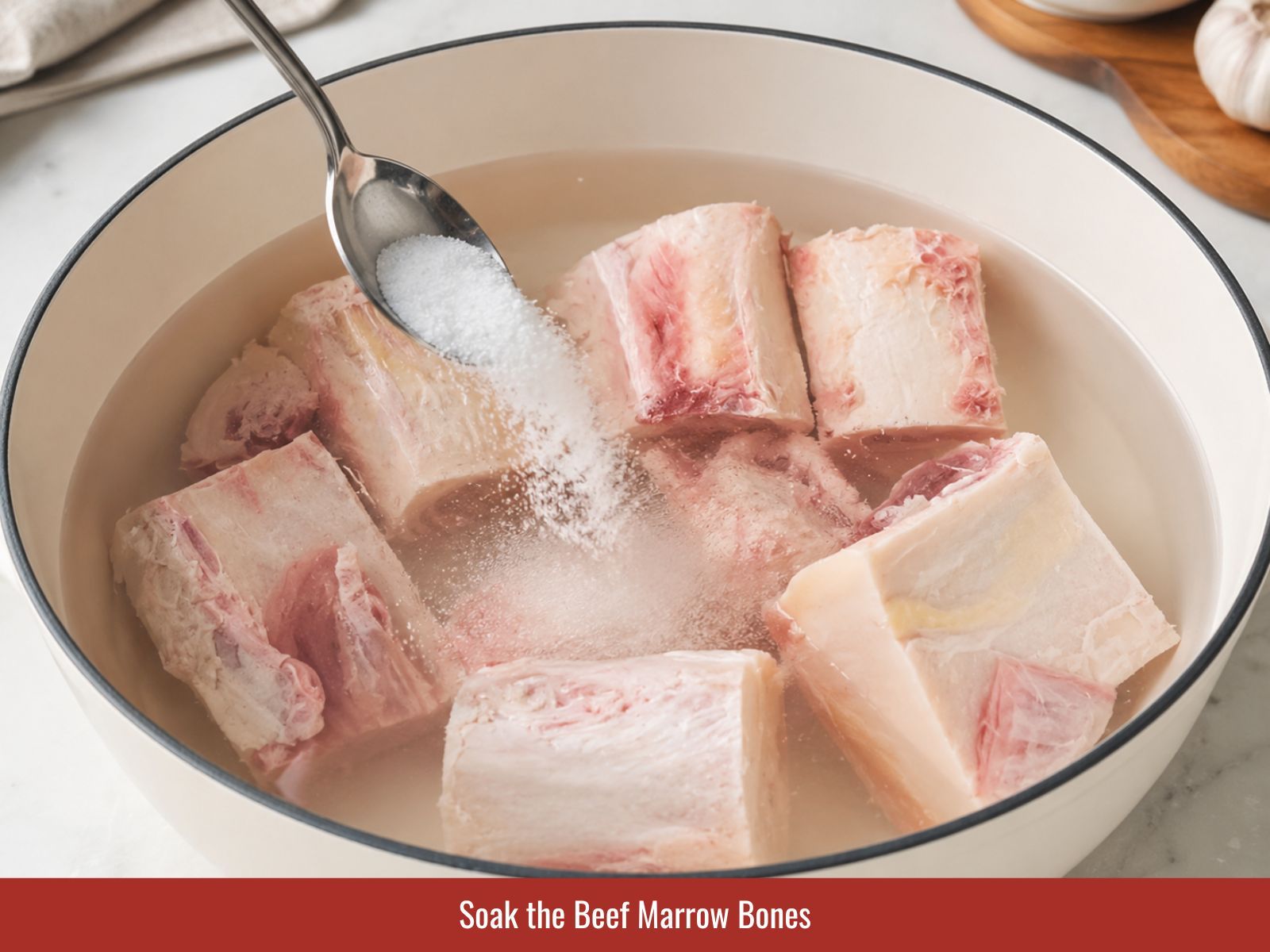
Step 1: Soak the Beef Marrow Bones
Put the beef marrow bones in 2 quarts (2 L) of water mixed with 2 tablespoons of salt and 2 tablespoons of white vinegar. Let them soak for 2 hours, then rinse them a few times under cold water until the water runs totally clear.
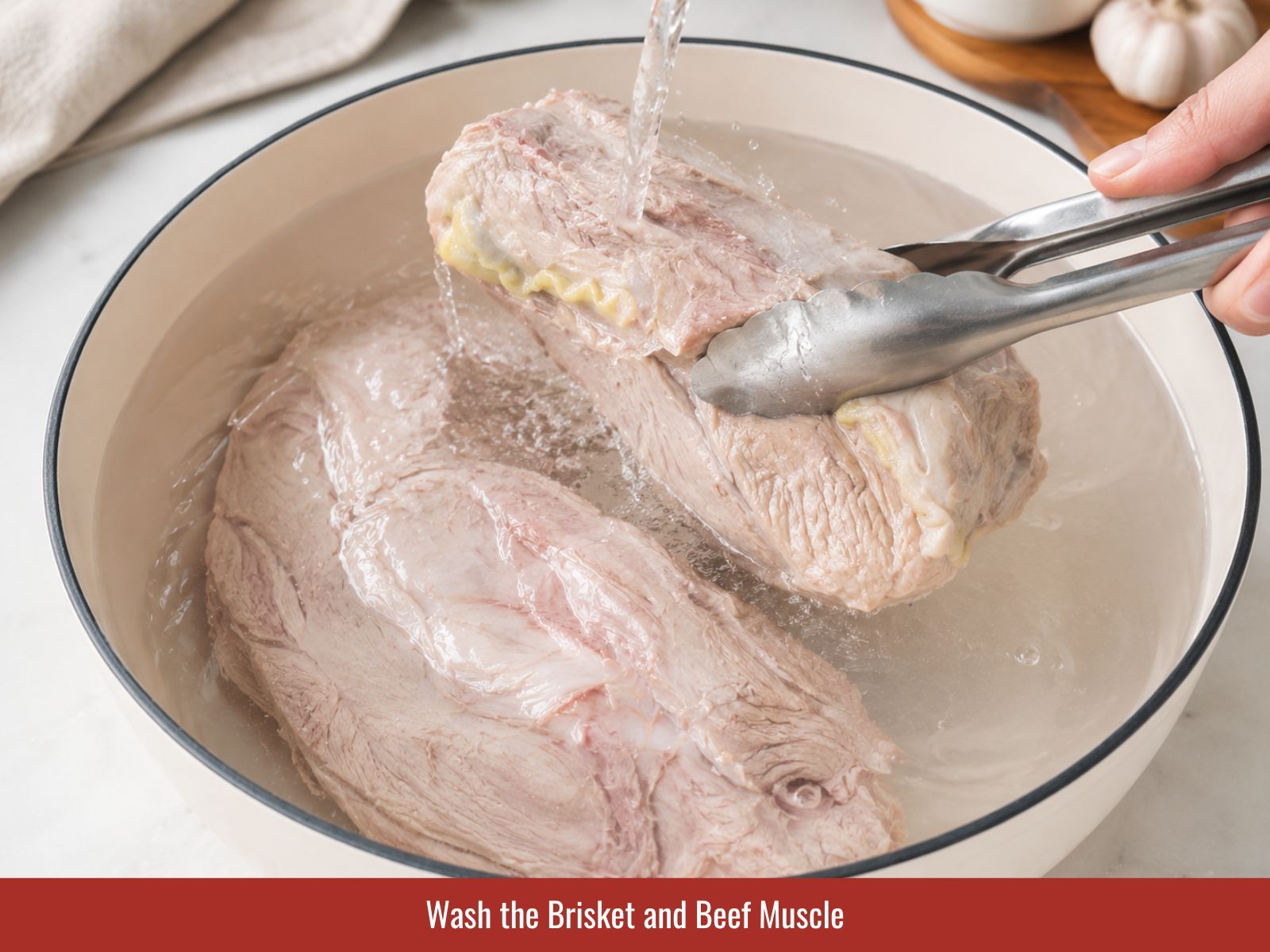
Step 2: Wash the Brisket and Beef Muscle
Put the brisket and beef muscle into 1 quart (1 L) of water, along with 2 tablespoons of salt, 4 tablespoons of rice wine, and a small piece of crushed ginger. Move the meat around and rub it well for 1 minute, then rinse it completely under cold water.
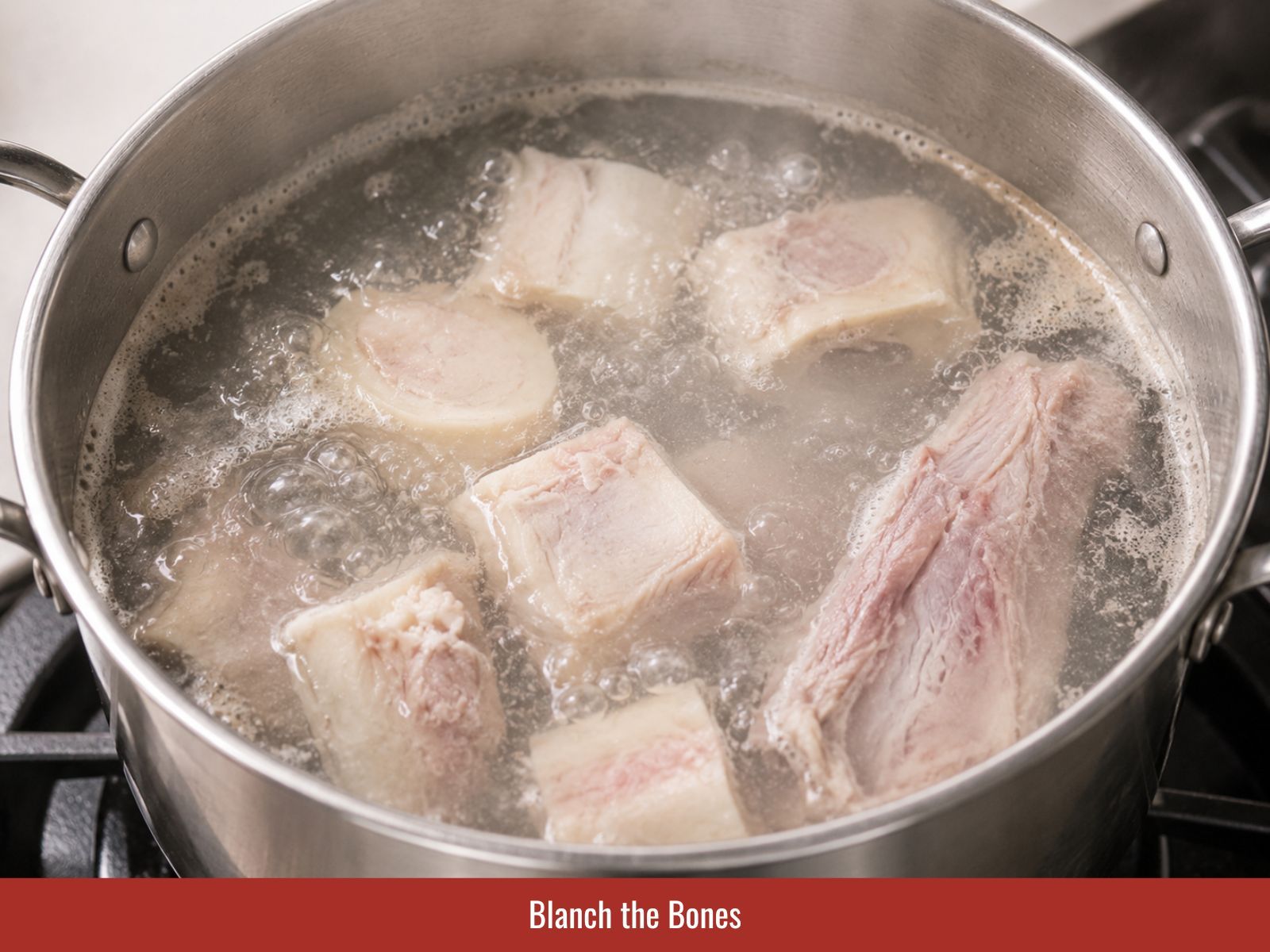
Step 3: Blanch the Bones
Drop the bones into a big pot, cover them up with cold water, and toss in ½ tablespoon salt, a little piece of ginger, and 2 sliced shallots. Turn the heat to high to bring it to a rolling boil, then let it cook for 5 minutes. Dump the water out, then wash each bone under the tap to clean off any foam or gunk.
This blanch-and-discard step, known as chần xương, is essential for producing a clear Hanoi-style broth. The initial boil draws blood and scum from the bones, and discarding the water removes these impurities before the long simmer begins.
Step 4: Blanch the Brisket and Beef Muscle
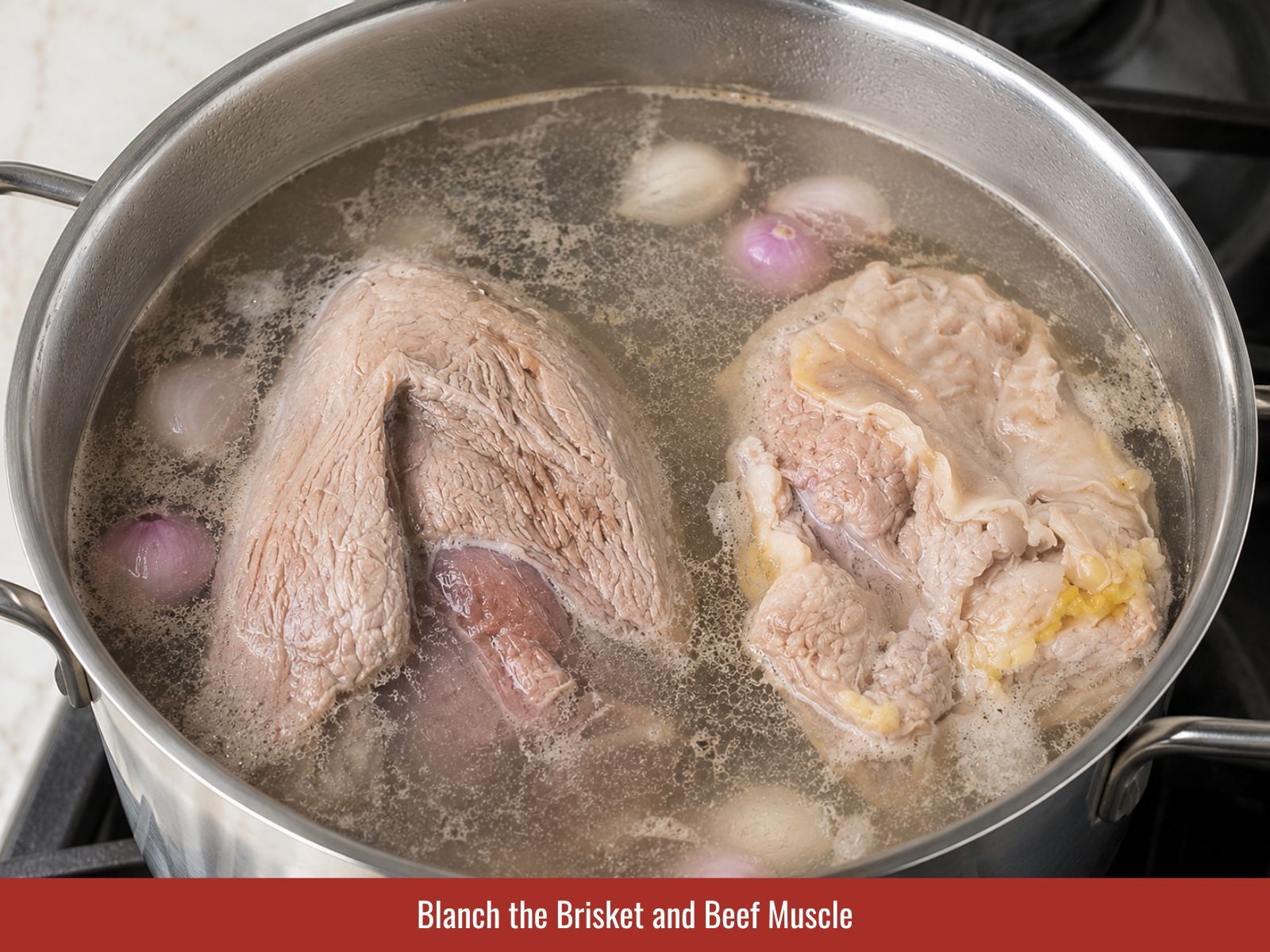
Put the clean pot right back on the stove with fresh water. Toss in the brisket and beef muscle, bring it to a boil, and cook it for 2 minutes. Pour the water out and wash the meat off until it is nice and clean.
Step 5: Start the Bone Broth
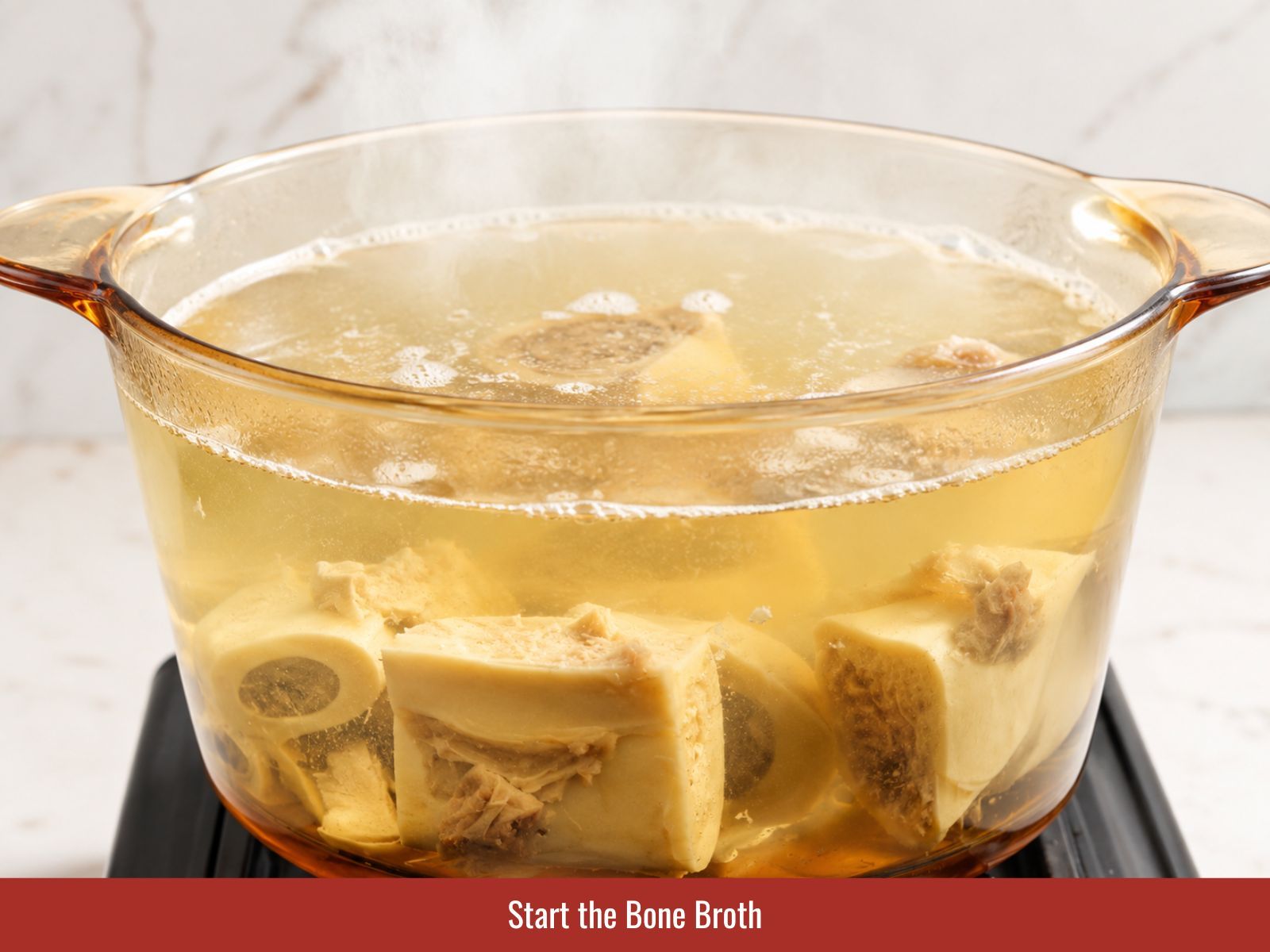
Put your cleaned bones into a big soup pot, one that holds at least 8 quarts. Pour in 1 gallon (4 L) of water, and then add ½ tablespoon of salt and roughly 10 g of rock sugar. Turn the heat up high to bring it to a boil.
Step 6: Skim and Reduce to a Low Simmer
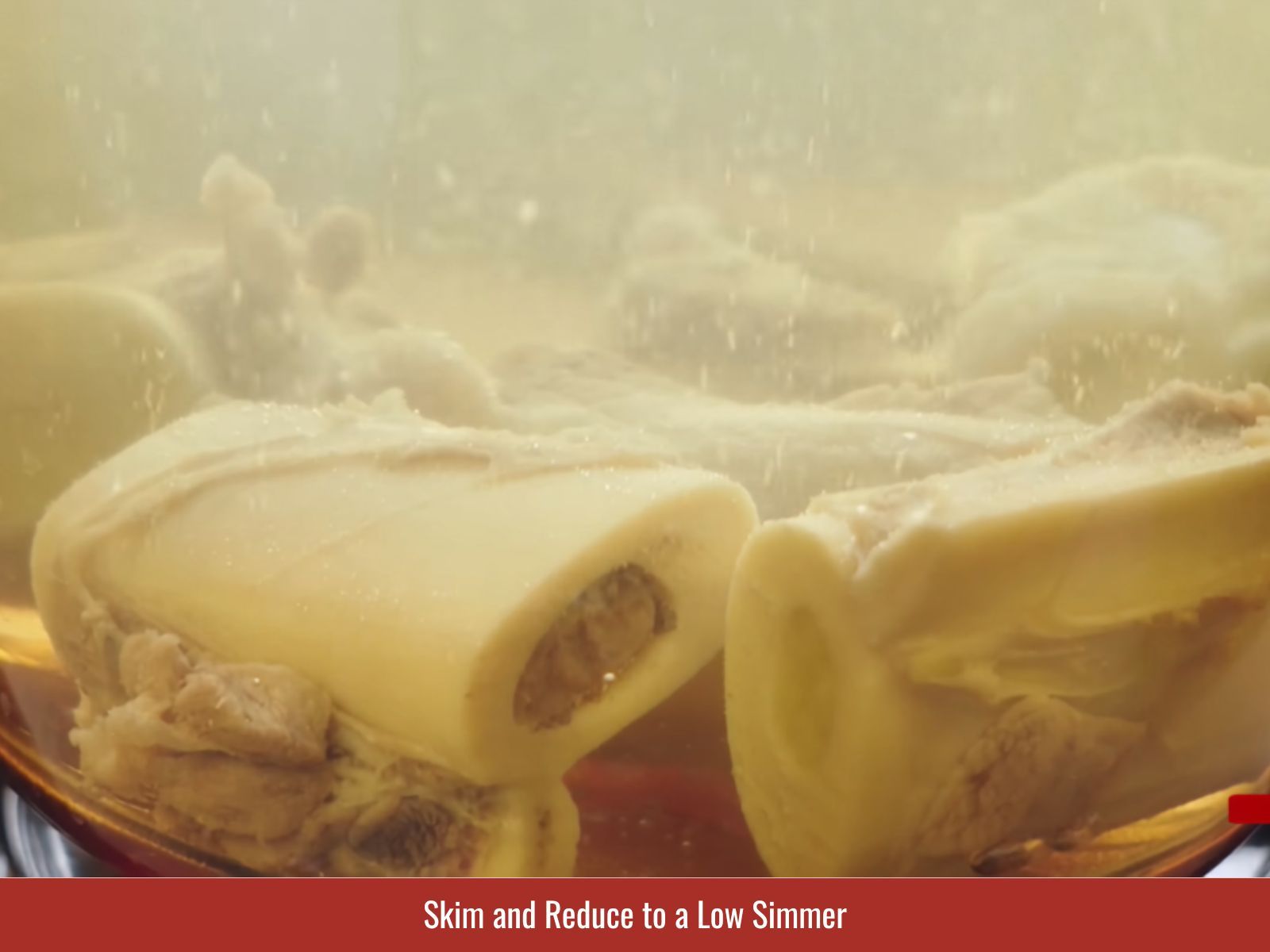
Scoop off all the foam until your soup looks clear, then turn the stove down to the lowest setting so the top barely moves instead of bubbling hard. Let it cook for 6 to 8 hours, scooping off the foam every 30 minutes during the first 2 hours. Top it up with boiling water whenever the soup gets low to keep the same amount in the pot.
Step 7: Boil the Brisket and Beef Muscle
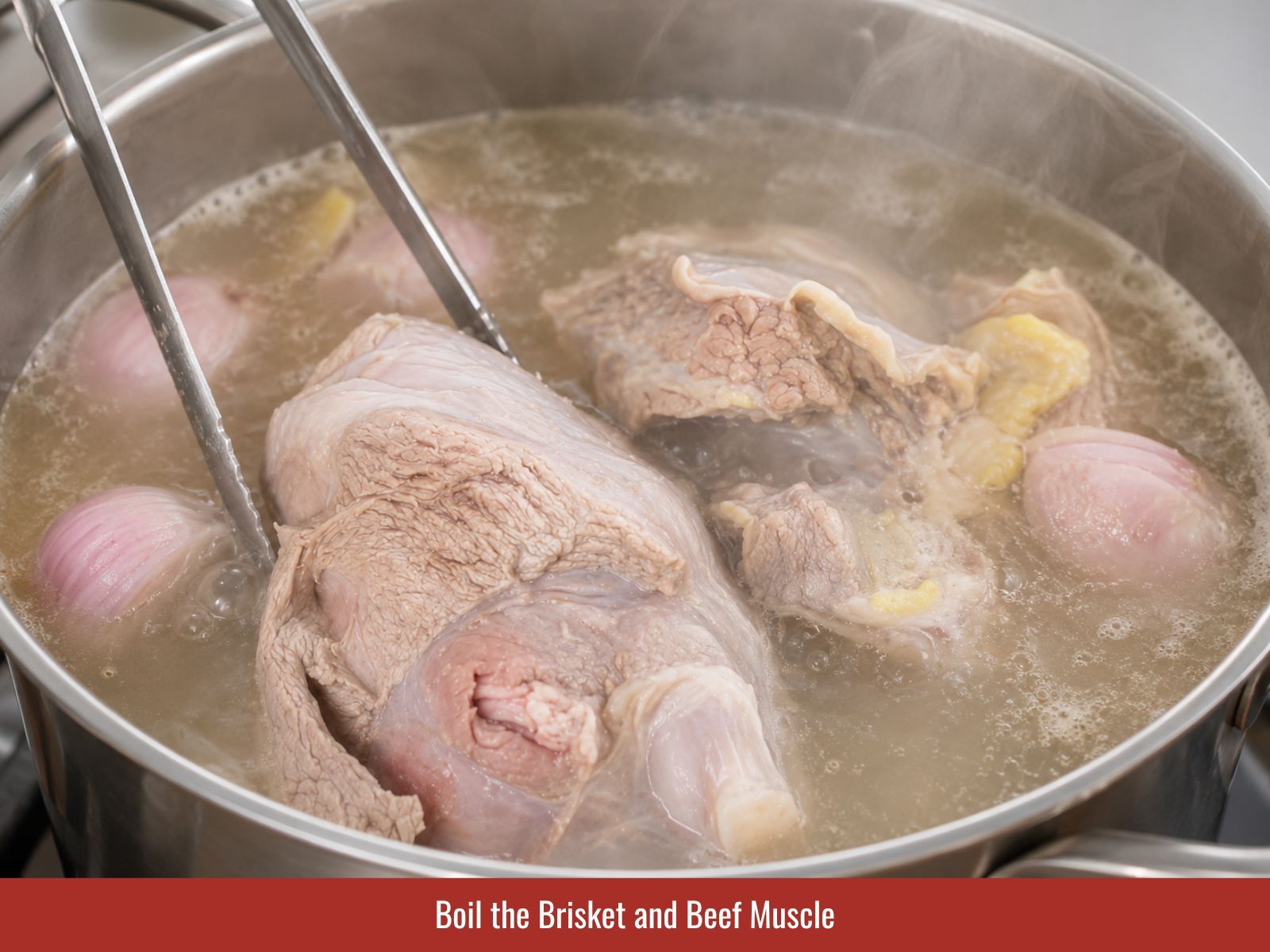
Grab a different pot and bring 2 quarts (2 L) of water to a boil. Toss in the clean brisket and beef muscle, ½ tablespoon salt, ½ tablespoon sugar, 1 oz (30 g) crushed ginger, and 4 roasted shallots. Let it cook softly for 2 hours or more, turning the meat over halfway through, until you can easily poke a chopstick straight through it.
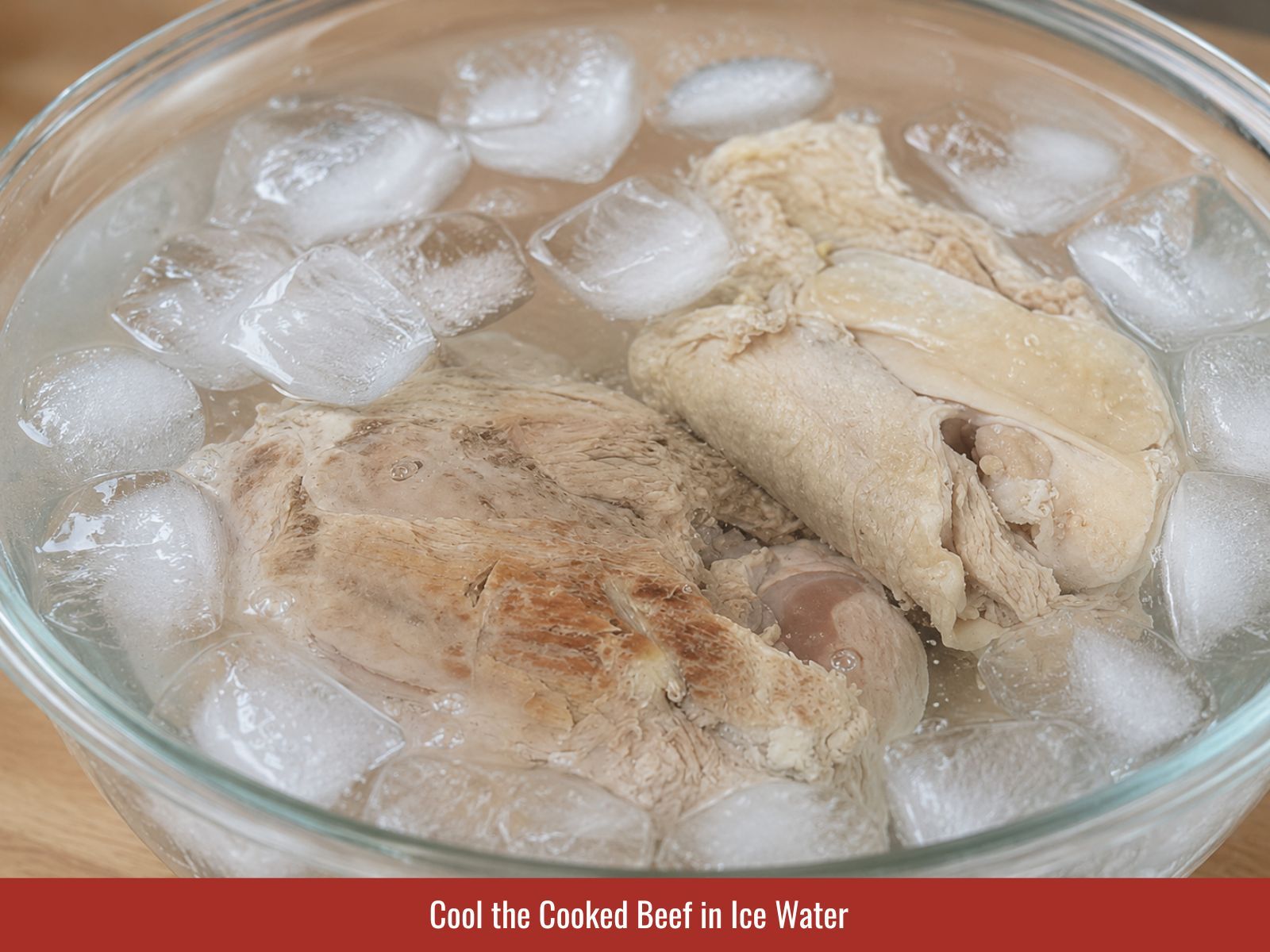
Step 8: Cool the Cooked Beef in Ice Water
Put the cooked beef right into a big bowl of ice water and let it sit for 10 minutes to stop it from cooking more and to keep it from turning dark. Dry the beef off with a paper towel and put it in the fridge until you are ready to cut it. Pour the liquid you used to cook the meat directly into your bone broth to add even more flavor.
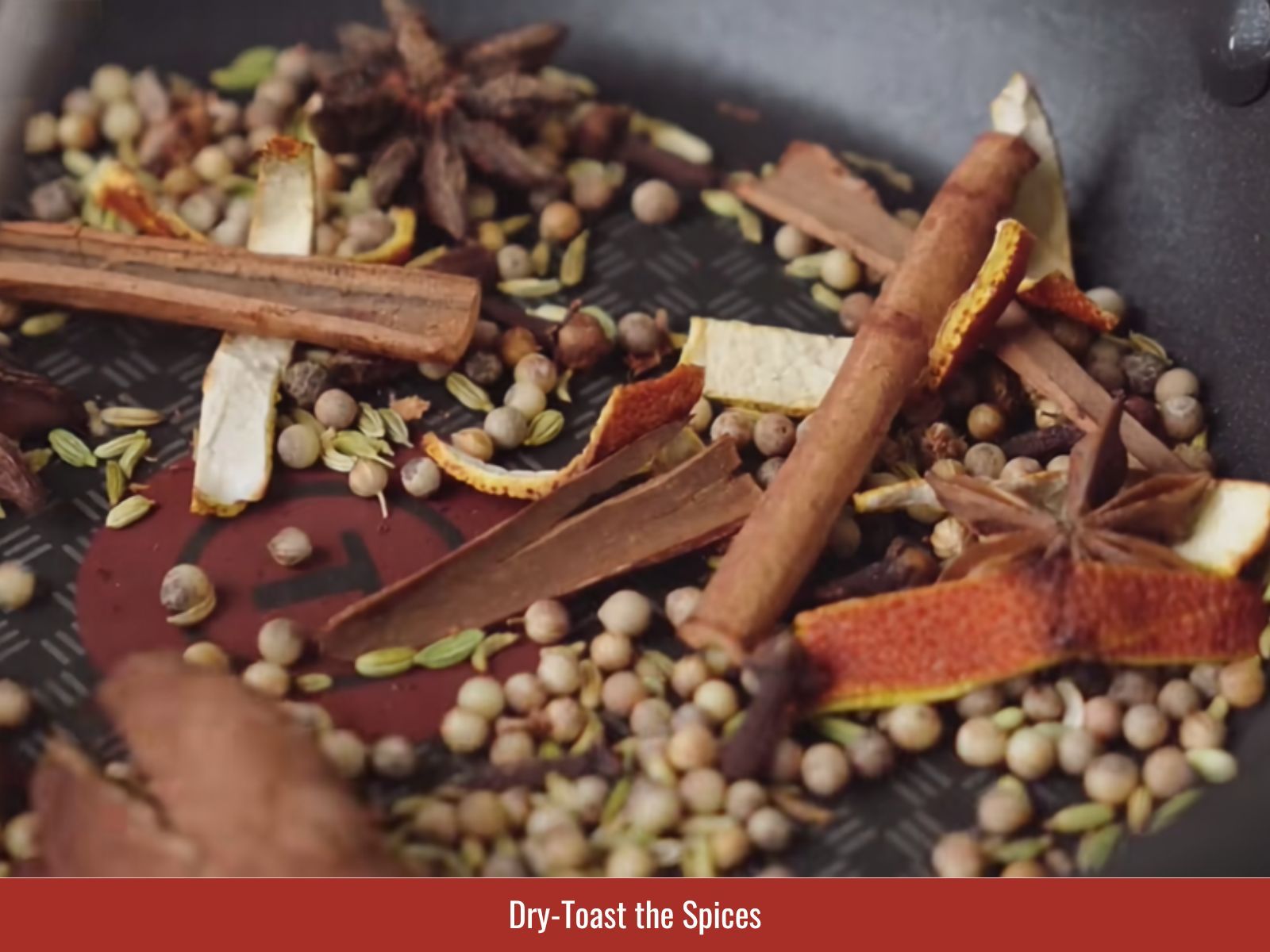
Step 9: Dry-Toast the Spices
Warm up a dry frying pan on medium heat. Toast the big spices first, like the cinnamon, star anise, black cardamom, and tangerine peel, for 30 seconds while moving them around. Throw in the smaller spices and toast them for about 1 more minute until they smell great, then dump them all into a small mesh bag or cloth pouch.
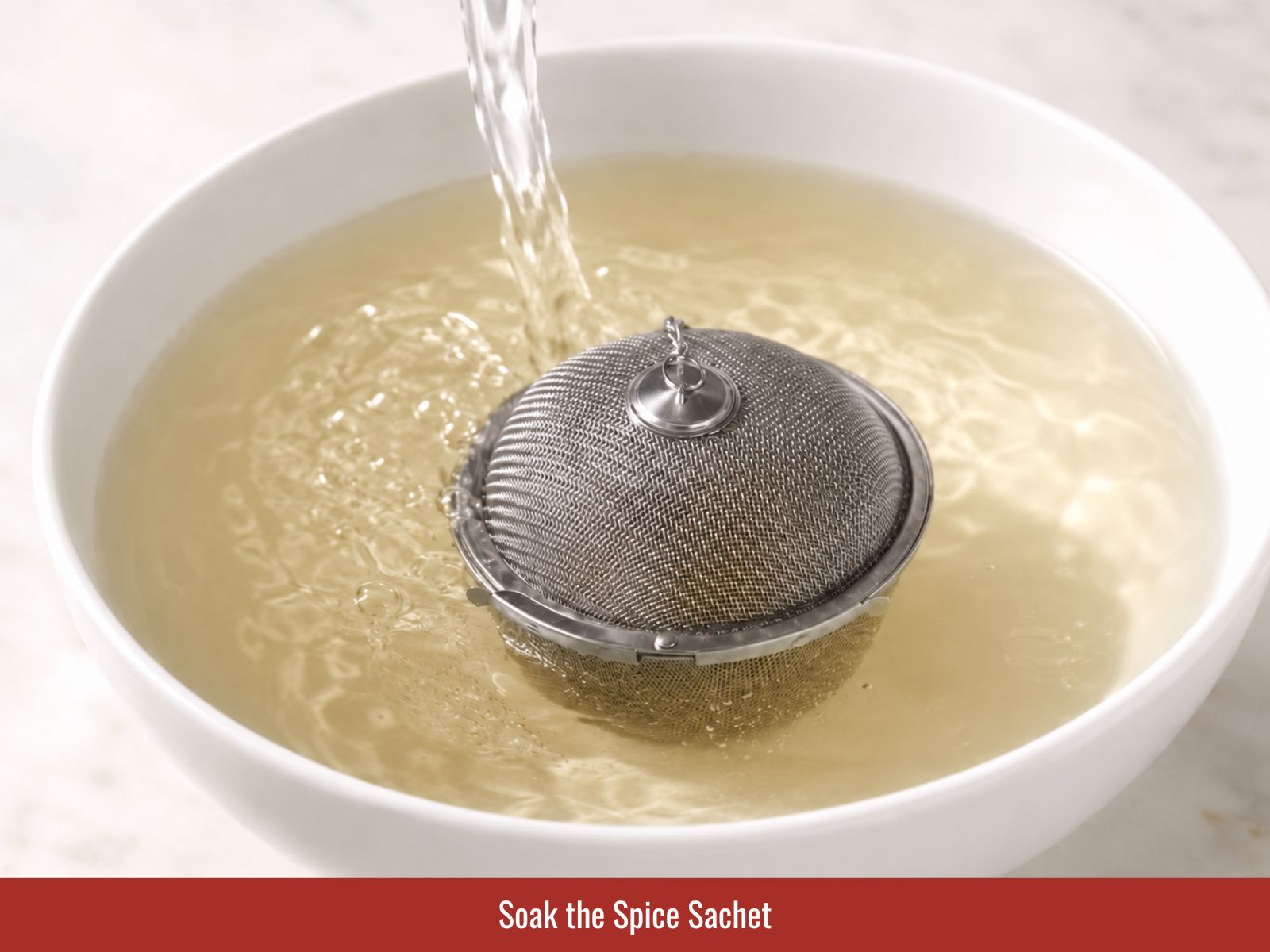
Step 10: Soak the Spice Sachet
Drop the spice bag into a bowl of boiling water and leave it alone for 15 minutes. Doing this early helps pull out any dark colors and bitter flavors, so your spices end up giving the soup a much cleaner, nicer smell.
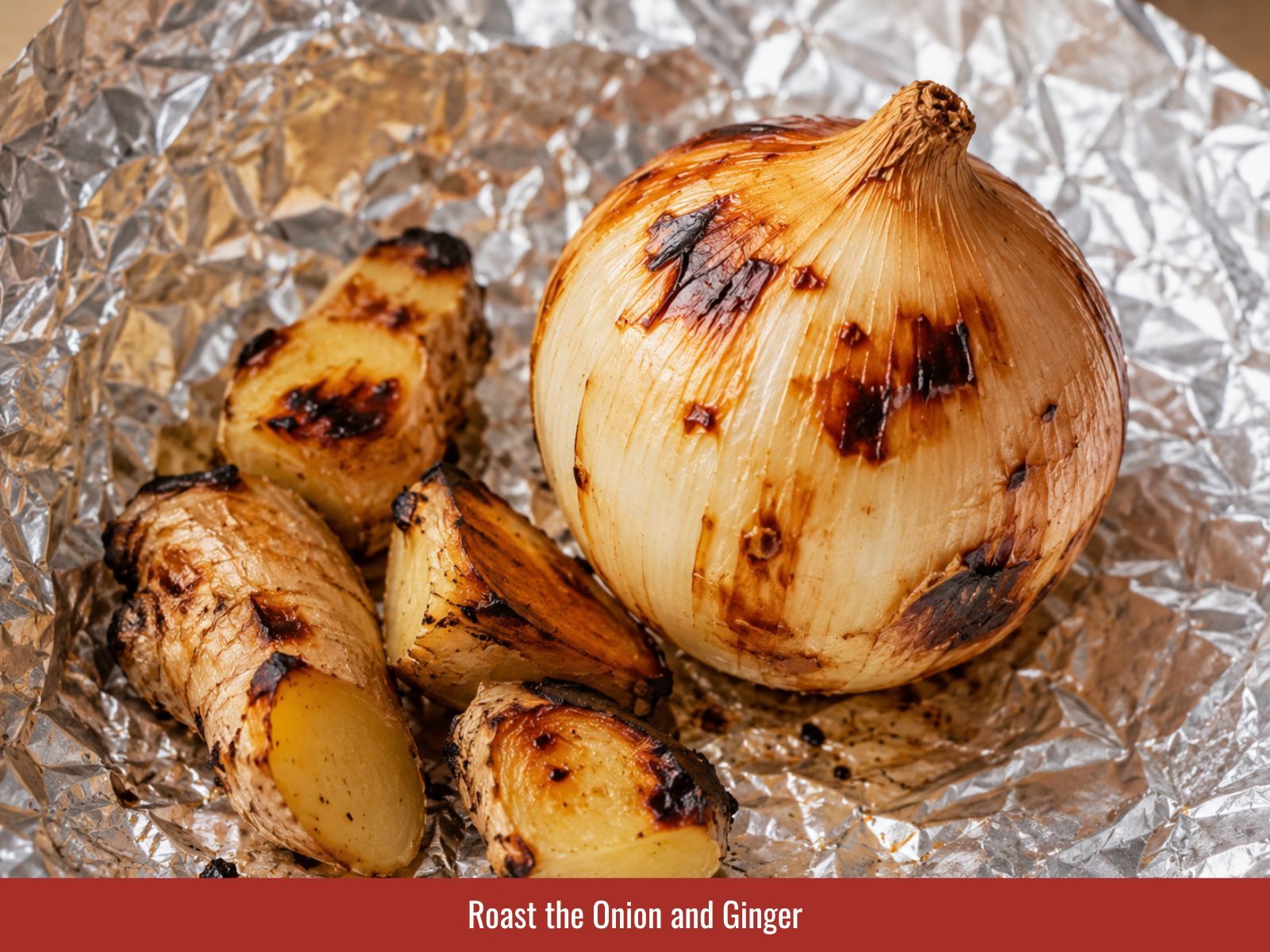
Step 11: Roast the Onion and Ginger
Wrap the whole onion and ginger in foil and bake at 375°F (190°C) for 15 minutes, until they are soft and fragrant. Unwrap, peel, and wash them off, then lightly smash the ginger and cut the onion in half. For a richer taste, you can burn them cut side down in a dry pan or under the broiler for 5 to 8 minutes instead, though this makes your soup a bit darker.
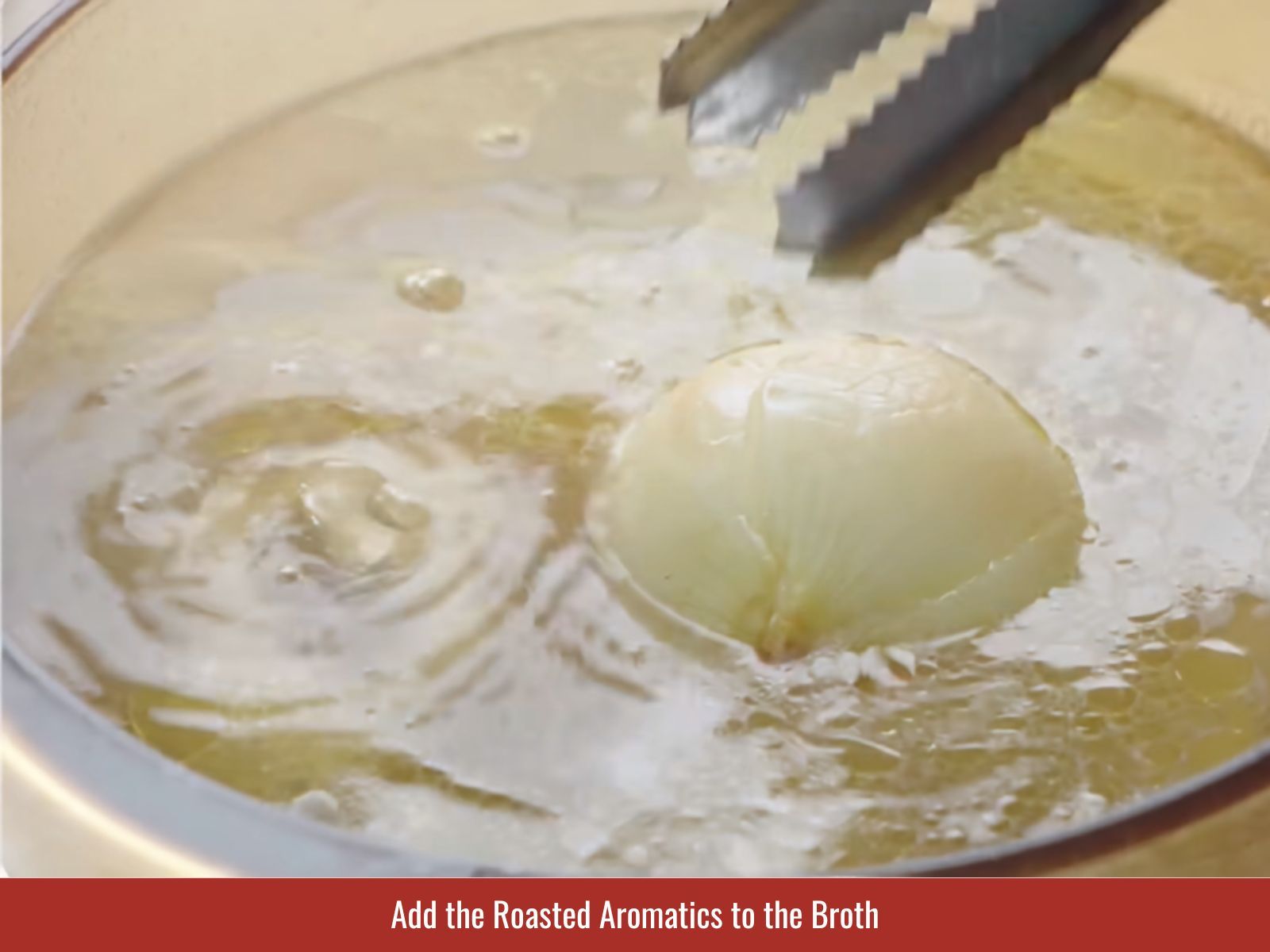
Step 12: Add the Roasted Aromatics to the Broth
After your soup has cooked gently for at least 4 hours, drop in the roasted onion and smashed ginger. Leave it on low heat for another 1 hour and 30 minutes with those veggies inside.
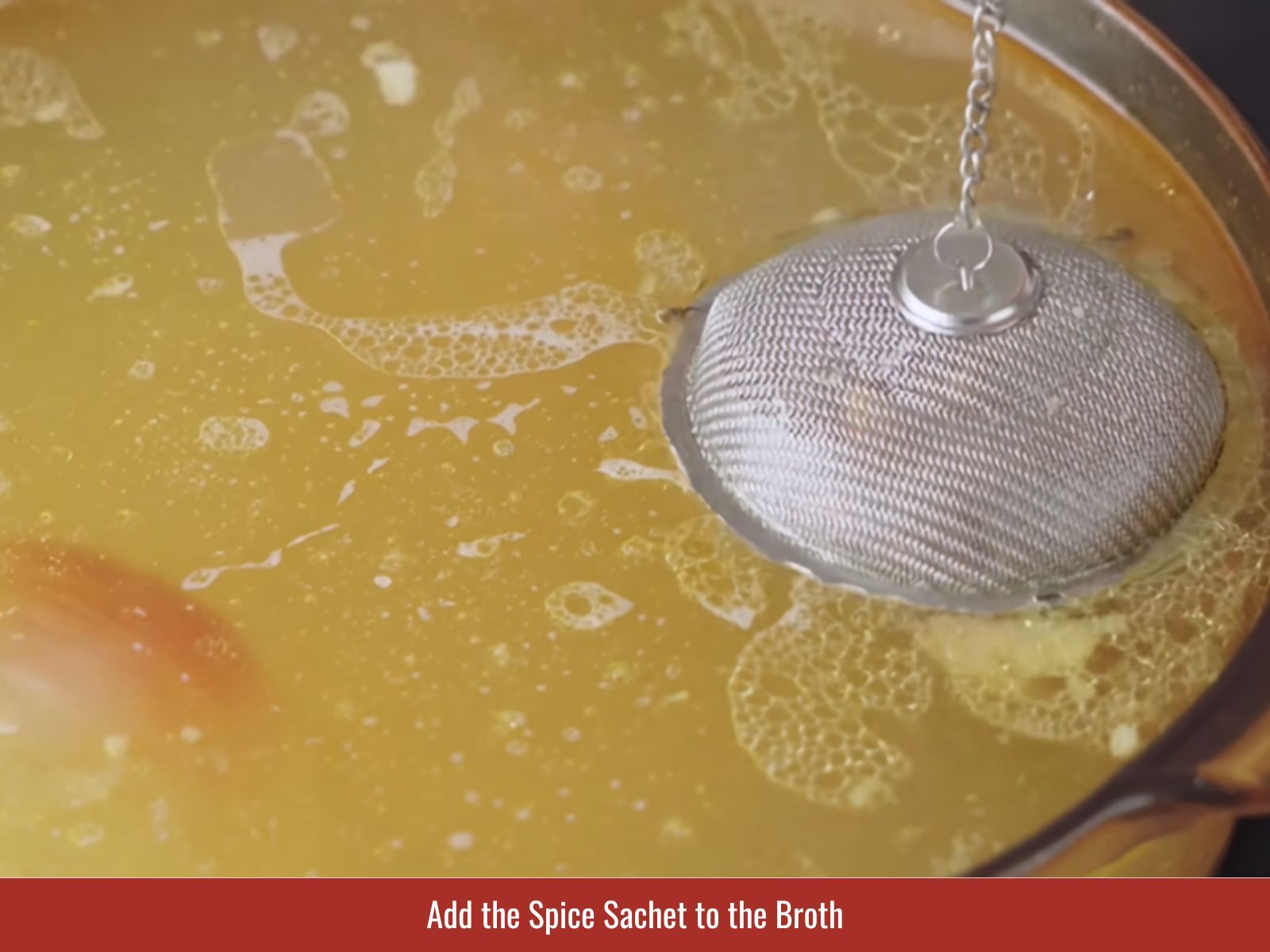
Step 13: Add the Spice Sachet to the Broth
After waiting 1.5 hours with the onion and ginger, drop your soaked spice bag right into the soup. Let it sit in there for 40 minutes, and then pull it out.
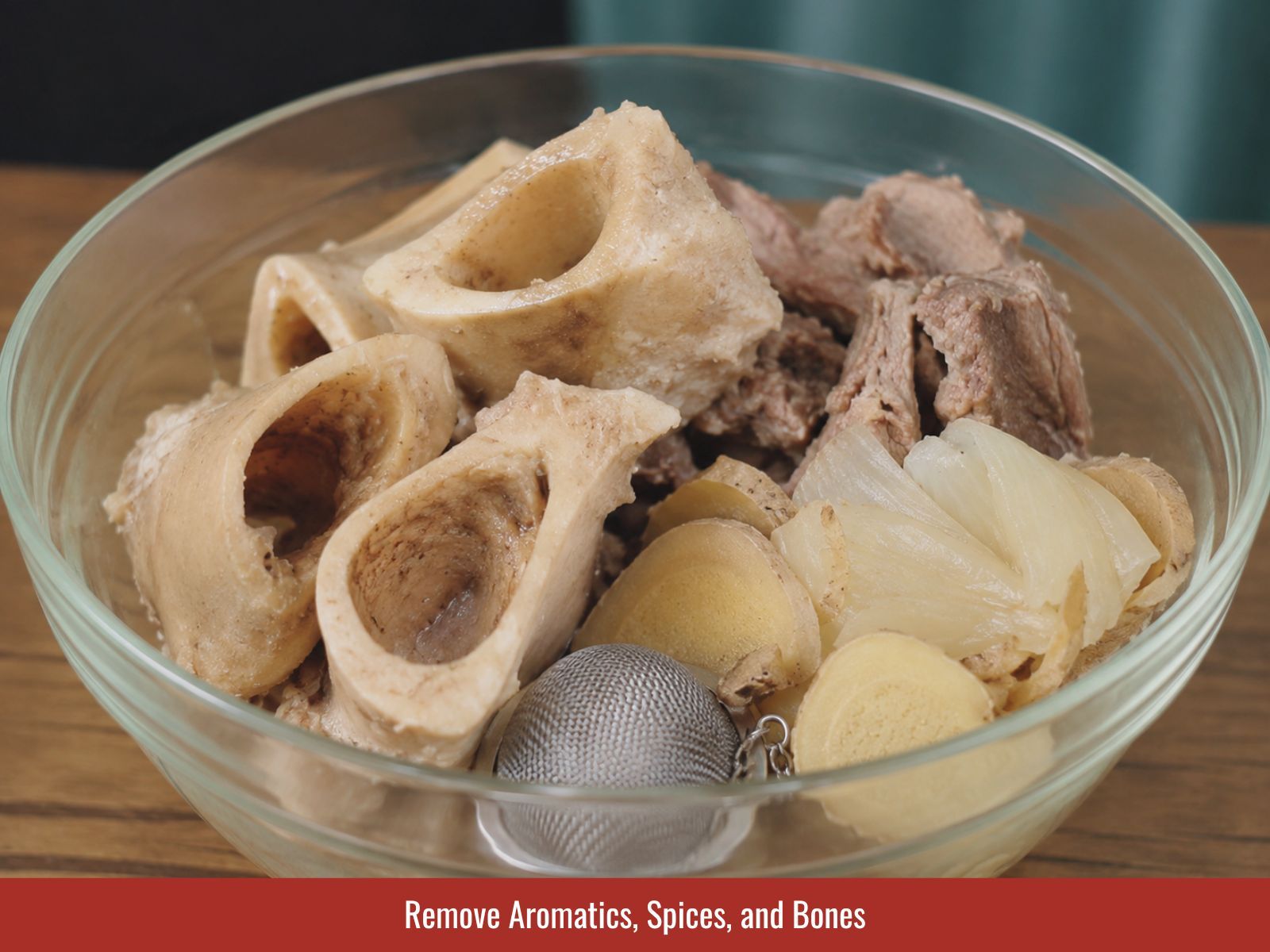
Step 14: Remove Aromatics, Spices, and Bones
Scoop out the onion, ginger, and all the bones. If you want a super clear soup, pour it through a fine strainer. Add boiling water to bring it right back up to the original 1 gallon (4 L).
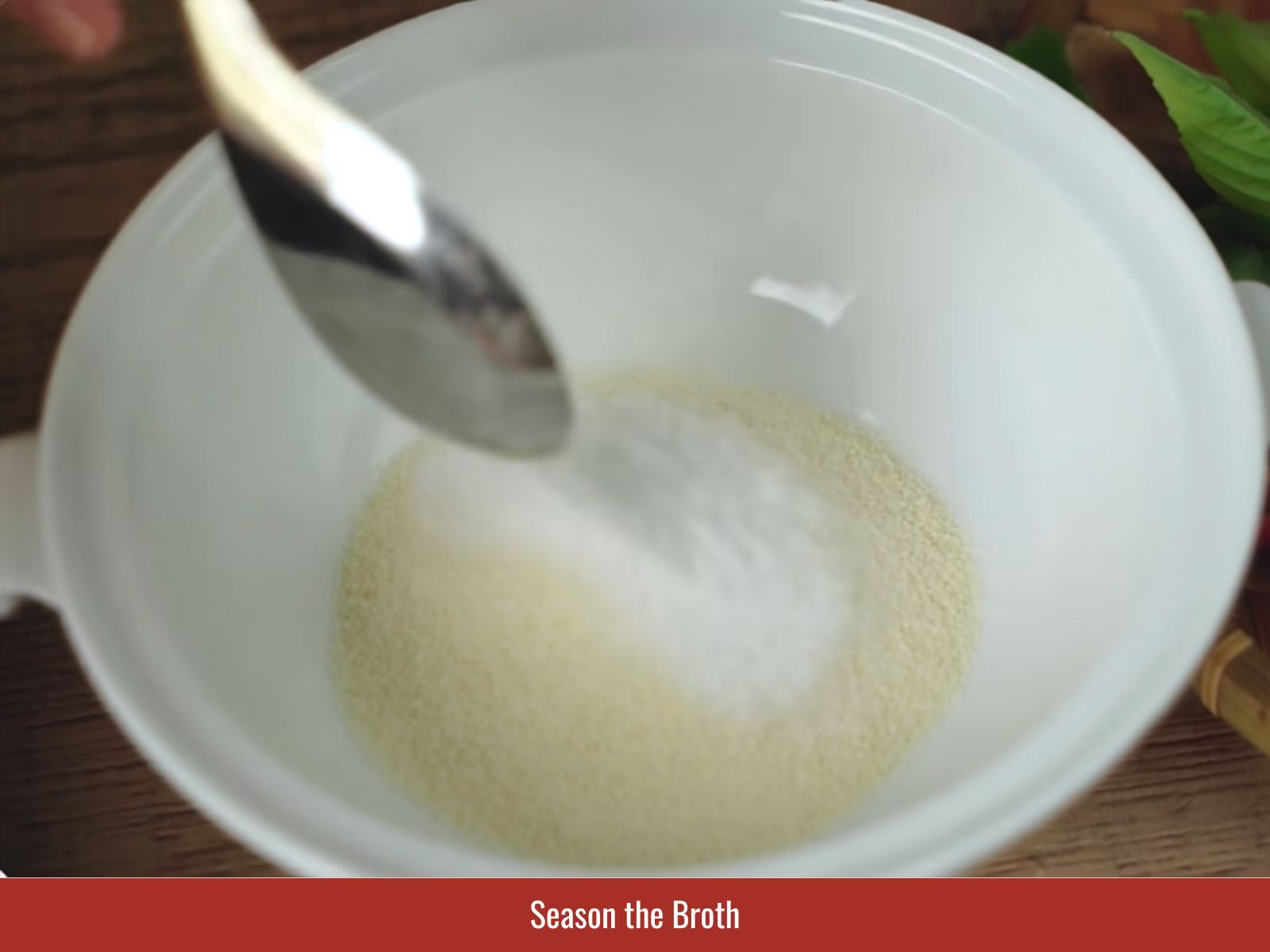
Step 15: Season the Broth
Melt 1.5 tbsp (22 g) salt, 4 tbsp (48 g) seasoning powder, 3 tbsp (45 g) rock sugar, and 1 tbsp (13 g) MSG in a little bit of hot soup, then stir it back into the main pot. Pour in 1 to 2 tablespoons of fish sauce to taste for that deep, savory flavor. Taste and adjust things until your soup is savory, a bit sweet, and finishes clean.
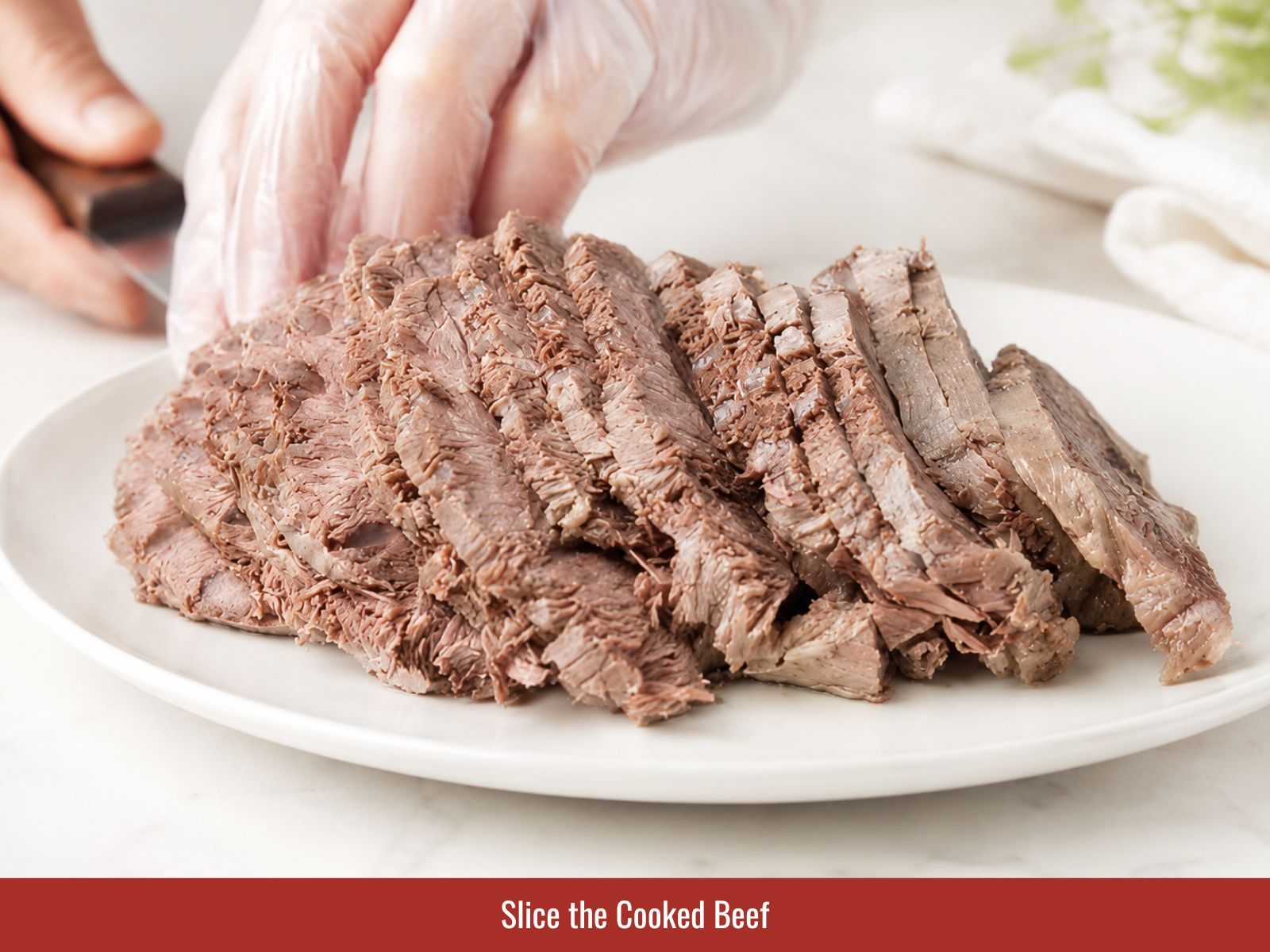
Step 16: Slice the Cooked Beef
Take the cold beef from the fridge. Cut the brisket across the grain into thin slices about ⅛ inch (3 mm) thick, and do the beef muscle the same way. Chilled beef slices nice and even, taking much less effort.
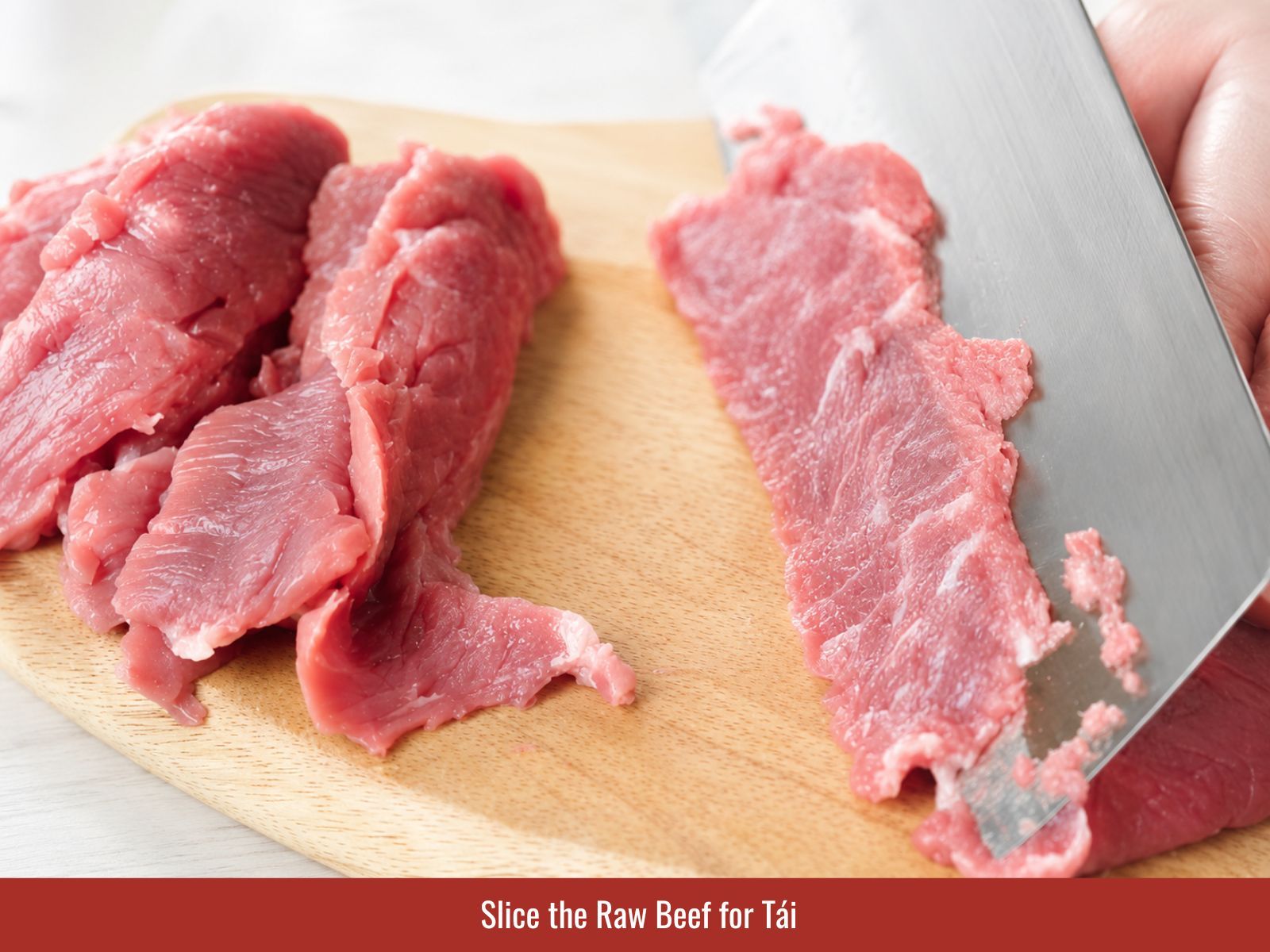
Step 17: Slice the Raw Beef for Tái
Put the boneless steak in the freezer for 15 to 20 minutes, until the edges firm up while the middle stays soft. Cut the steak across the grain as thin as you can, staying under ⅛ inch (about 2 mm).
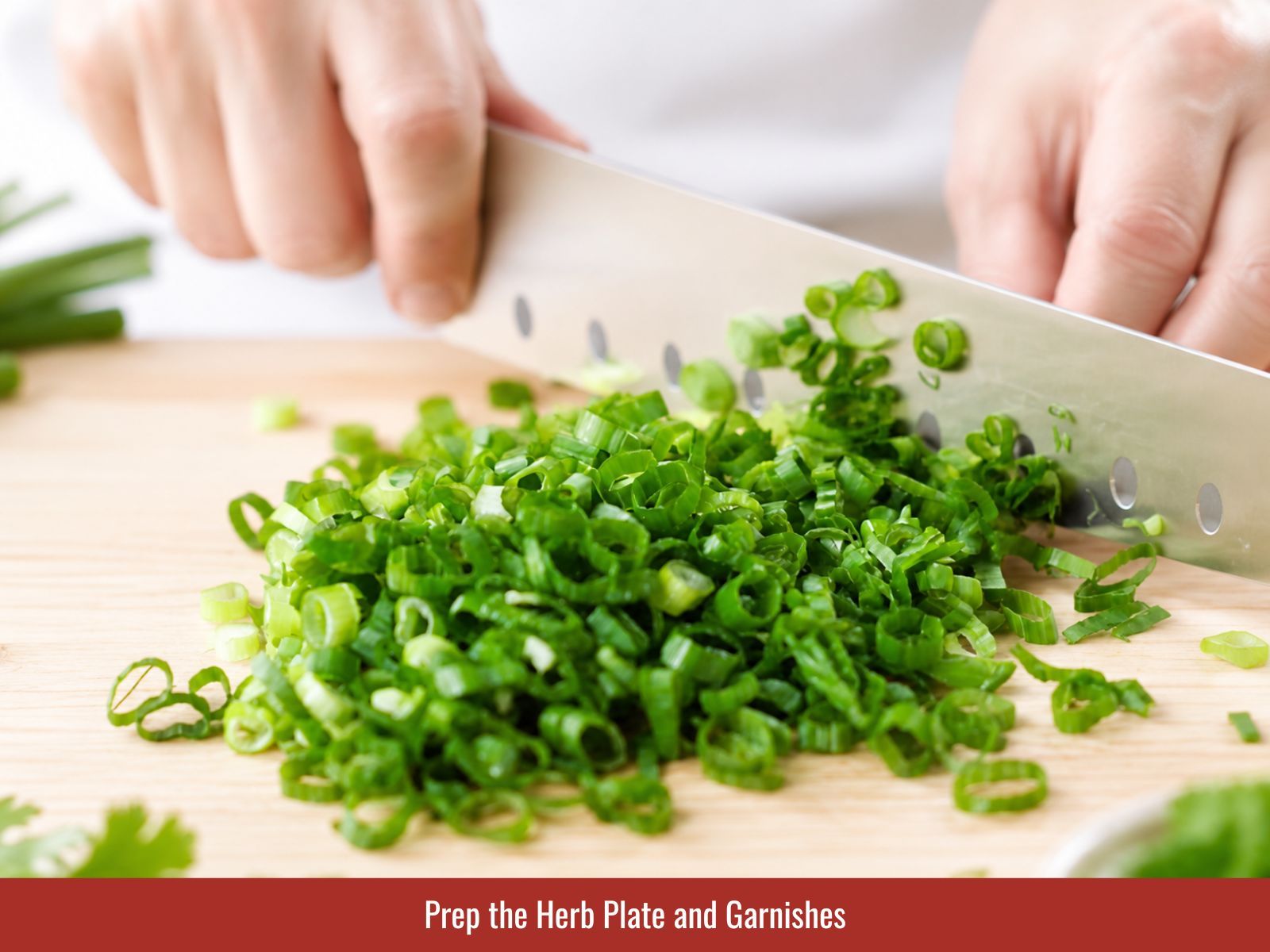
Step 18: Prep the Herb Plate and Garnishes
Cut the onion into thin rings and soak in ice water for 10 minutes to kill the bite and add crunch. Chop the green onion whites into 2-inch (5 cm) pieces for boiling, and cut the green tops into small pieces. Cut the lime into wedges, slice the chili, wash the bean sprouts, and pick out the fresh basil and sawtooth herb.
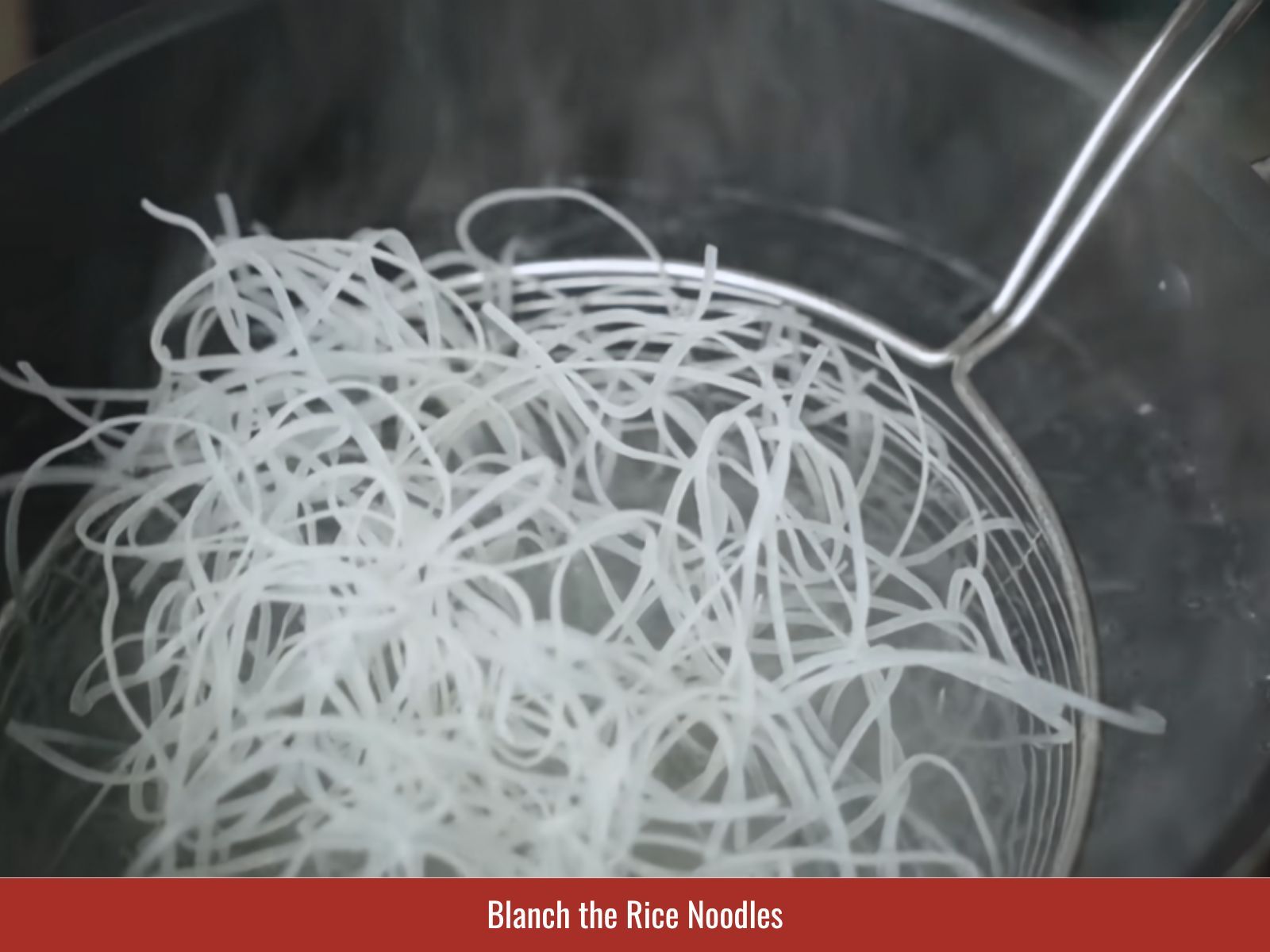
Step 19: Blanch the Rice Noodles
Get a big pot of water boiling hard. Toss the rice noodles in and cook them for 30 seconds if fresh, or 5 to 7 minutes if dried. Drain them and shake off any extra water.
Step 20: Assemble the Bowl
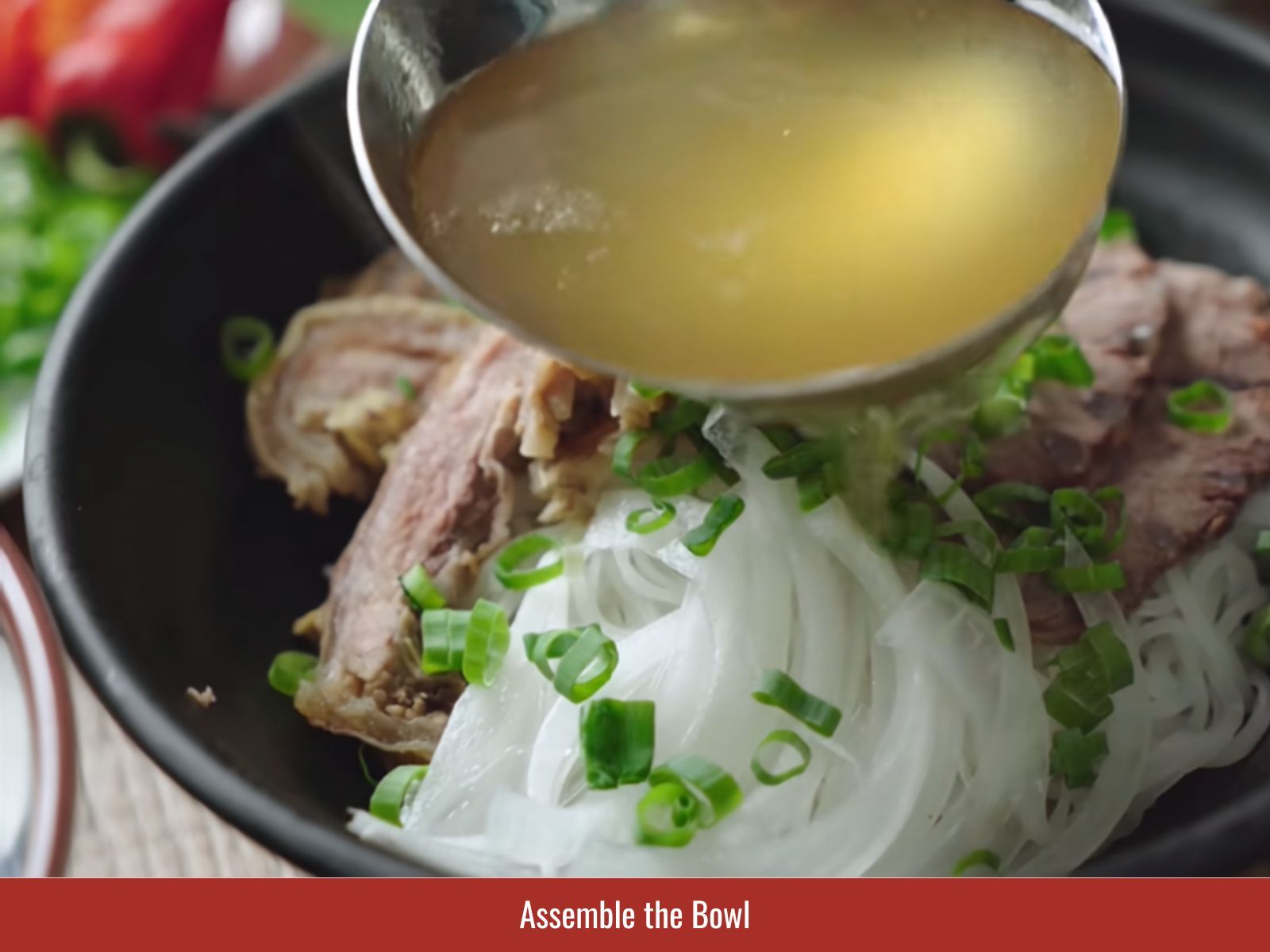
Warm up each serving bowl with boiling water and pour it out, because a bowl that stays hot until your last bite makes great pho. Put in some boiled noodles, lay the sliced brisket and muscle on one side, and the medium-rare beef (tái) slices on the other.
Toss some cut onions and chopped green onions on top. Pour boiling-hot broth straight over the raw beef, so it turns nice and pink in just seconds, then serve it immediately with the fresh herb plate, lime wedges, hoisin sauce, and chili sauce on the side.
How to Serve Beef Pho
Beef pho is served as a build-your-own bowl. The bowl comes out with just noodles, beef, and hot soup, and everything else goes on the side. The classic setup is:
- Rice noodles, fresh or dried.
- Thinly sliced raw beef (tái) that cooks to a perfect medium-rare when you pour hot broth over it.
- Bean sprouts, Thai basil, and cilantro to add as you eat.
- Lime wedges.
- Hoisin sauce, chili sauce, or sriracha.
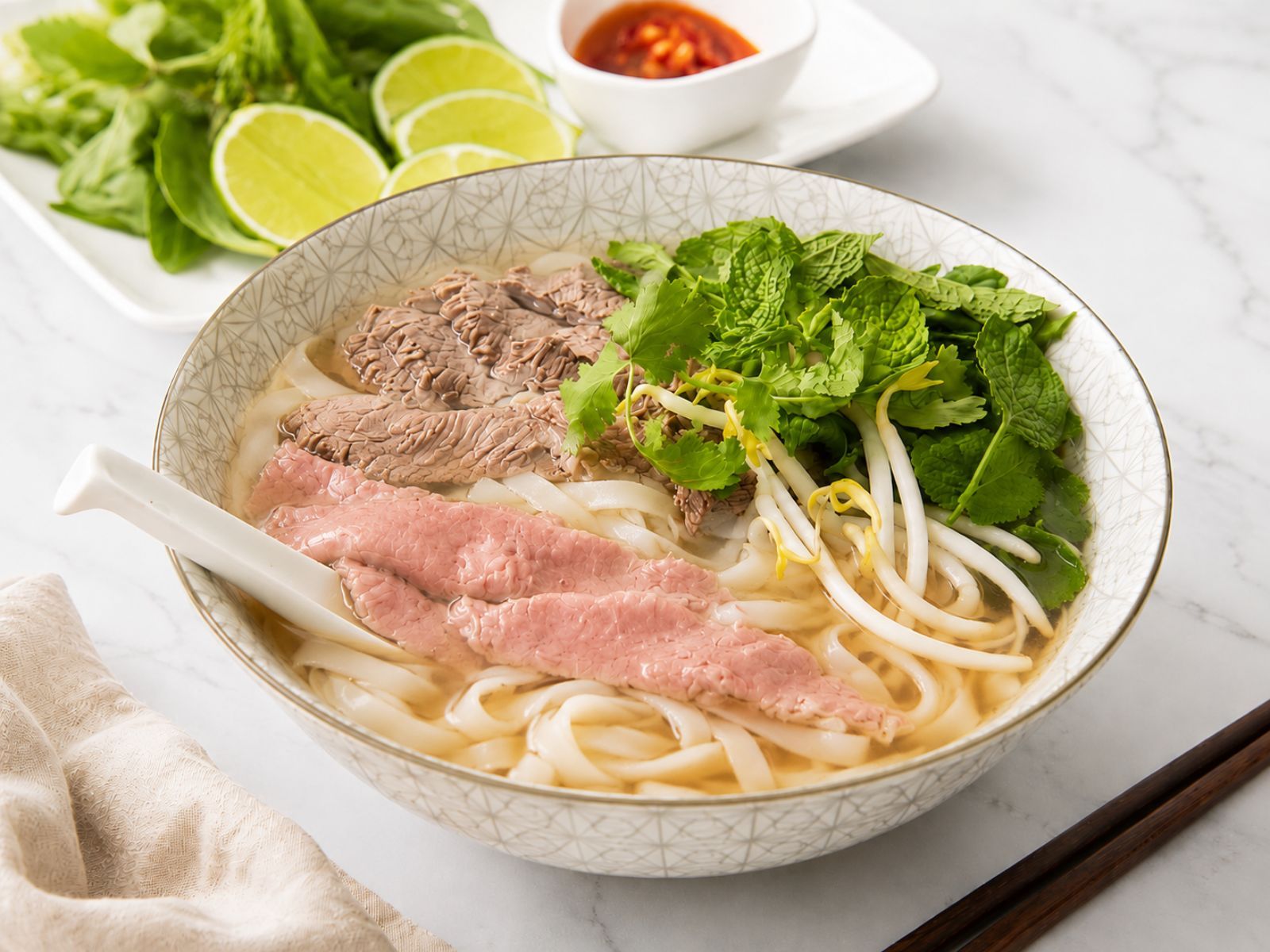
In Vietnam, eating pho is a staple of the morning routine. You grab a bowl at a street stand before work, fixing it up as you go with a squeeze of lime, some torn-up basil, or a spoonful of chili sauce. The soup should be hot enough that the fresh herbs soften up the second they hit the surface.
Hold your chopsticks in 1 hand for the noodles and beef, and a spoon in the other, switching between sips and bites. For extra heat, we really like CHIN-SU hot sauce, since its roasted celestial chili (ớt chỉ thiên) and garlic flavors pair so well with the star anise and cinnamon in the soup.
Common Beef Pho Accompaniments
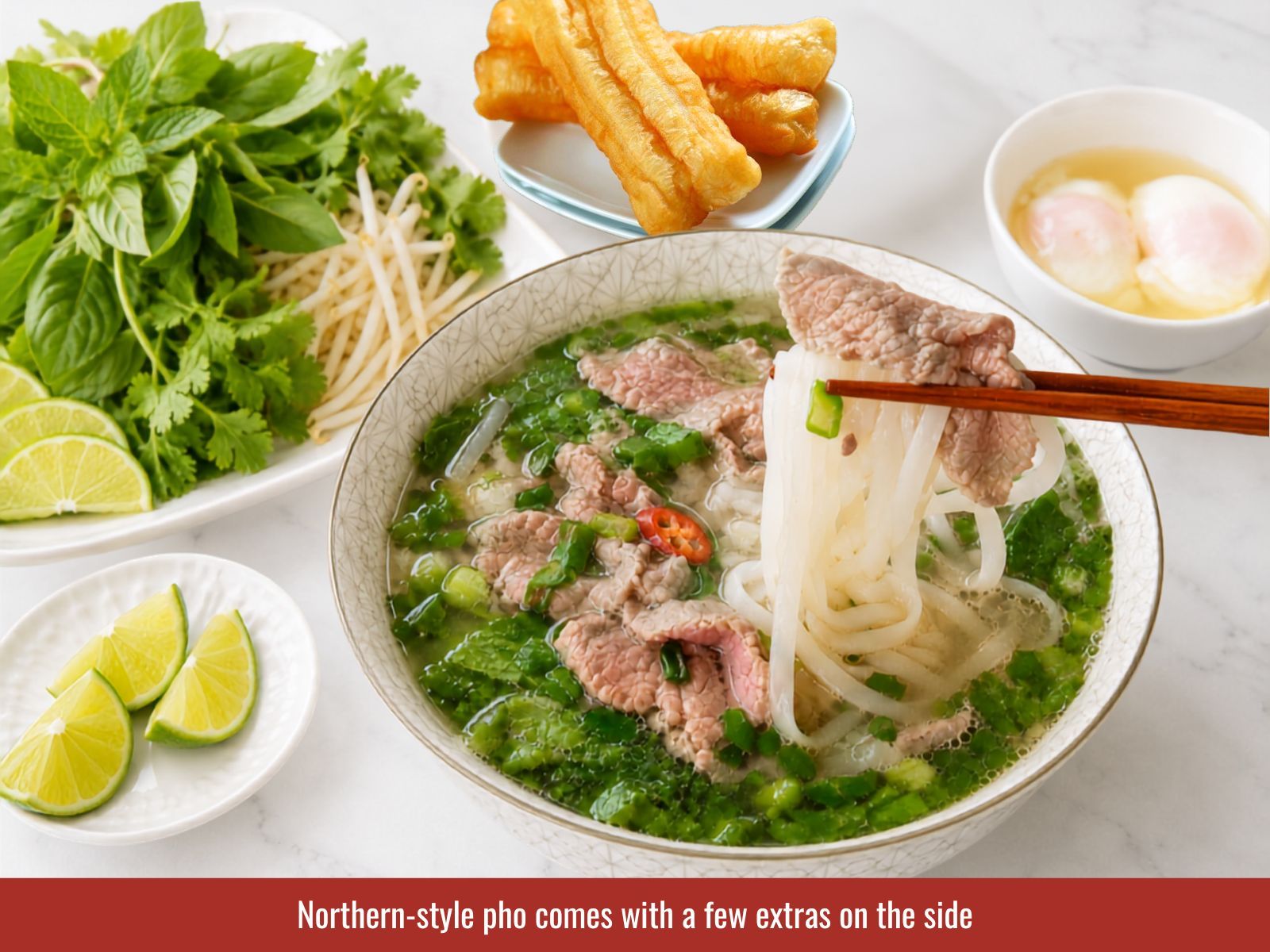
Northern-style pho comes with a few extras on the side, so just set out whatever you like:
- Paper-thin onion slices with shredded white green onions, plenty of thin green onions, and cilantro.
- Fried dough sticks (quẩy), cut into short pieces for dipping right into the soup.
- A poached egg, cooked separately and served on the side, or dropped right into your bowl.
- Garlic slices in vinegar (tỏi ngâm) to help balance out the rich flavor.
- Lime wedges and celestial chili for some fresh flavor and heat.
Tips for the Best Beef Pho
These are 5 small choices that separate a good beef pho from a great beef pho.
- Keep the simmer barely visible. A hard boil makes the broth cloudy, so just let the top ripple, not bubble.
- Pre-soak the spice bag for 15 minutes. A boiling-water soak removes raw bitterness and excess color, so your spices smell nicer and cleaner.
- Roast the onion and ginger until soft, not black. Burning them darkens the soup, while a gentle roast keeps it clear and slightly sweet.
- Boil the brisket separately from the bones. The bones cook for 6 to 8 hours to develop deep flavor, while the brisket needs only 2 hours to become tender.
- Warm up a ceramic bowl before you serve. A cold bowl drains the heat fast, but a warm ceramic bowl stays hot to the very last bite.
What Can You Substitute or Change in Beef Pho?
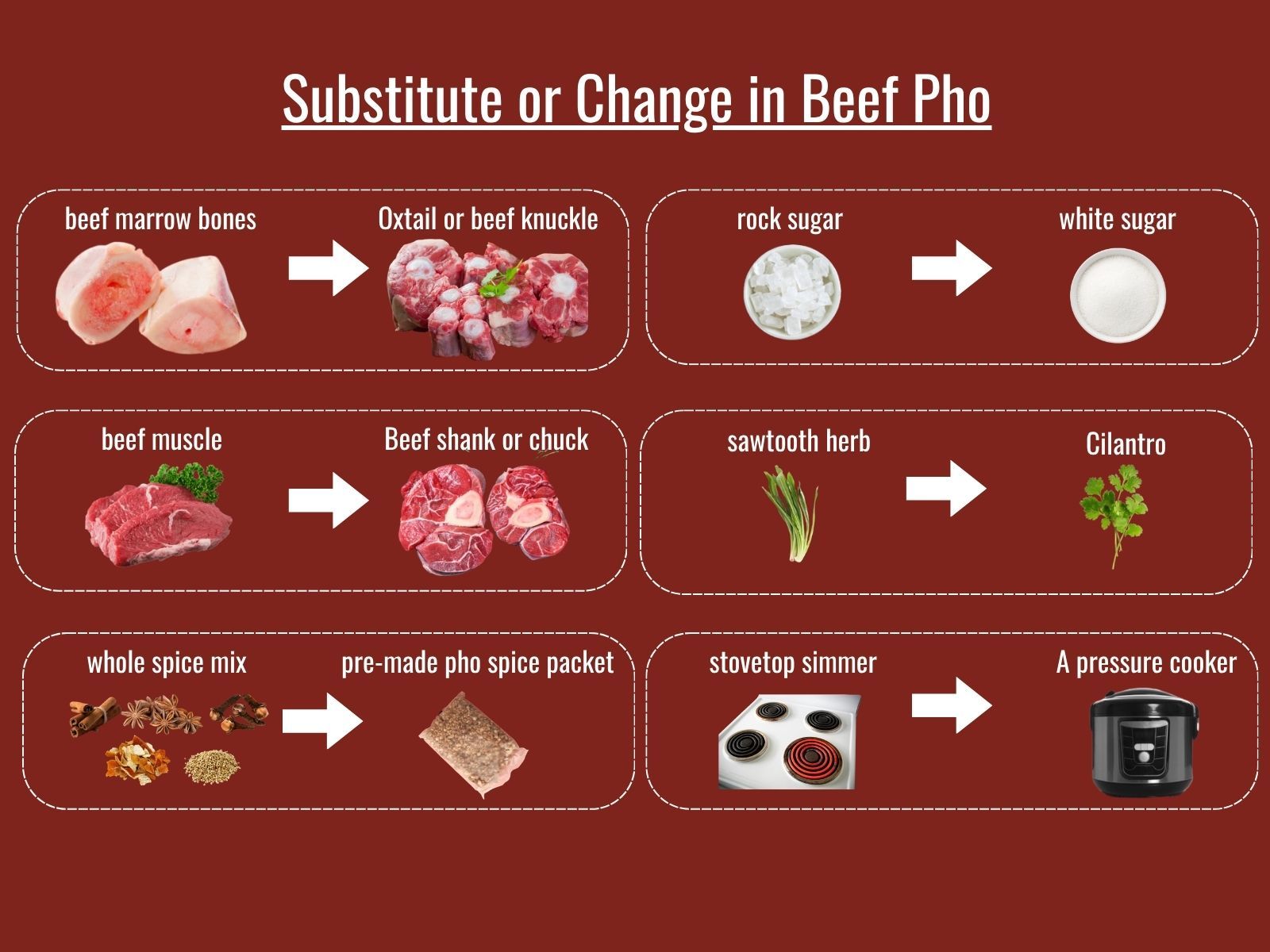
These 7 simple swaps help you make beef pho using common US grocery store ingredients without sacrificing the dish's true flavor.
Ingredient swaps
- Oxtail or beef knuckle can stand in for beef marrow bones. Oxtail adds more gelatin and a richer soup, and both are really easy to find at US meat counters or Asian butchers.
- Beef shank or chuck replaces the beef muscle. Beef shank has more tough parts for a long boil, while chuck is much easier to find but can break down a little sooner.
- A pre-made pho spice packet (gói gia vị nấu phở) replaces the whole spice mix. The packet runs under $2 at most Asian stores. It is super handy and balanced, but slightly milder than toasting your own. Grab it when hunting down 8 spices feels like too much work.
- Plain white sugar can replace rock sugar (đường phèn). Rock sugar gives a cleaner, lighter-tasting sweetness, but if your store does not have it, just use a little less regular white sugar instead.
- Black cardamom (thảo quả) has no real replacement, so just leave it out rather than swapping. Its smoky flavor is very unique to Vietnamese pho, so treat black cardamom as optional, even though the soup loses some depth without it.
- Cilantro is a good substitute for the sawtooth herb (ngò gai). Cilantro misses that sharp herbal bite but still works out fine, and most Asian grocery stores carry sawtooth herb if you really want the original.
- Dried tangerine peel (trần bì) is perfectly fine to just leave out. Dried tangerine peel is pretty tough to find outside Asian herb shops, and your soup stays perfectly balanced without it.
Cooking method
- A pressure cooker (Instant Pot) can replace the stovetop simmer. After a quick boil, add your bones, water, and seasonings, then cook on high pressure for 90 minutes to make a clear, sweet soup that tastes almost exactly like the stovetop version.
Make swaps where you have to, but the closer you stick to the original ingredients, the closer you get to that classic Northern Vietnamese flavor.
How to Store Beef Pho?
Beef pho tastes best right off the stove, so you will usually only store it for leftovers or when cooking ahead of time. If you do have to keep it, store each part in its own container, because they all hold up differently.
Keep the strong broth in a sealed container in the fridge for 3 to 5 days, or freeze it for up to 3 months; when you want some, just add hot water and bring it to a rolling boil before serving. Try not to save watered-down broth at the end of the day. It will not go bad overnight, but the flavor really falls flat.
Keep the cooked brisket and muscle sealed up in the fridge for 3 to 4 days, or freeze them for later. Then just slice them cold and warm them up in your hot soup. Fresh rice noodles really should not sit out overnight, since they get hard and lose their bounce. Cook them fresh every time or put them in the fridge for 1 to 2 days max. Keep them away from fruit and seafood, because they soak up smells super fast.
Wash the herbs, dry them off, wrap them in a wet paper towel, and keep them in the fridge drawer for 1 to 2 days. Wrap the raw tái beef tightly, keep it in the fridge for 1 to 2 days, or freeze it for longer, and never leave it sitting out on the counter.
Let us know if you have tried making beef pho at home yet or if you are still gathering your bones and spices. Drop your thoughts, changes, or results right in the comments, and if this recipe worked out for you, leaving a quick star rating really helps other home cooks find it. Share a picture of your finished bowl on social media with #CHINSU, since we love to read every single one. If you want to see if CHIN-SU hot sauce fits perfectly in your bowl, just grab a bottle at chinsu.com and give it a try.
Frequently Asked Questions
Vietnamese noodle shops usually offer 6 common cuts of beef, and each one has its own name and feel:
- "Tái" is thin, raw beef that cooks to medium-rare right in the hot soup.
- "Chín" (nạm) is fully cooked brisket, boiled until it gets super soft.
- "Gầu" is fatty brisket that offers a softer, richer bite.
- "Gân" is chewy beef tendon.
- "Sách" is beef tripe, if you are a fan of those extra parts.
- "Bò viên" are nice bouncy beef meatballs.
Most spots let you mix these up, and "phở tái nạm" (rare beef and brisket) is definitely the most popular bowl in Vietnam.
A normal bowl of beef pho comes out to about 350 to 450 calories, depending on the portion size, how many noodles you add, and how much fat stays in the soup. The soup stays light because you scoop off the fat as it cooks, but adding hoisin sauce and extra beef will raise that number.
Yes, you totally can. After boiling the bones and veggies quickly, just pressure cook everything on high for 90 minutes. The soup comes out nice, clear, and sweet. You will not get the exact same deep flavor as cooking it for 6 to 8 hours on the stove, but it is way better than buying store-bought soup and just mixing in spices.
Northern-style pho (phở Bắc), like the kind from Hanoi, has a cleaner, simpler soup with just a few toppings: usually green onions, cilantro, and a little squeeze of lime. Southern-style pho (phở Nam), as you find in Saigon, is sweeter and spicier, and it comes with a big plate of bean sprouts, Thai basil, sawtooth herb, hoisin, and chili sauce. This recipe leans more toward the Northern style.
Traditional beef pho is totally gluten-free right from the start. The noodles are made from rice, and the soup is just bones and spices with absolutely no wheat. Keep an eye on 2 things, though: some seasoning powders (hạt nêm) and hoisin sauce can contain wheat. So check your labels and swap in tamari or coconut aminos if you need to worry about gluten.
Beef Pho Recipe
1. Ingredient
Bones and Beef
- 3.3 lb (1.5 kg) beef marrow bones (xương ống).
- 2.2 lb (1 kg) beef muscle (bắp bò).
- 1.75 lb (800 g) beef brisket (nạm bò).
- 1.1 lb (500 g) boneless beef steak (bò tái).
Broth Spices and Aromatics
- 6 g cinnamon.
- 3 whole star anise.
- 7 whole cloves.
- 5 g dried tangerine peel.
- 5 g coriander seeds.
- 10 g white peppercorns.
- 3 black cardamom pods.
- 3 g cumin seeds.
- 2 oz (60 g) fresh ginger.
- 1 large onion, about 14 oz (400 g).
Broth Seasoning
- 3 tablespoons (45 g) rock sugar.
- 1.5 tablespoons (22 g) salt.
- 4 tablespoons (48 g) seasoning powder.
- 1 tablespoon (13 g) MSG (optional).
- 1 gallon (4 L) water.
- 1–2 tablespoons fish sauce, to taste.
Noodles, Herbs, and Toppings
- 1.5 lb (700 g) flat rice noodles (bánh phở).
- Bean sprouts.
- Thai basil.
- Sawtooth herb (ngò gai).
- Green onions.
- Lime wedges.
- Fresh chili slices.
- Thinly sliced onion soaked in ice water.
- Hoisin sauce and chili sauce.
2. Instructions
- Step 1: Soak the Beef Marrow Bones. Soak marrow bones in 2 quarts (2 L) water with 2 tablespoons salt and 2 tablespoons white vinegar for 2 hours. Rinse until water runs clear.
- Step 2: Wash the Brisket and Beef Muscle. Rub brisket and beef muscle with water, salt, rice wine, and crushed ginger for 1 minute. Rinse thoroughly.
- Step 3: Blanch the Bones. Boil bones with salt, ginger, and shallots for 5 minutes. Discard water, rinse bones, and clean the pot.
- Step 4: Blanch the Brisket and Beef Muscle. Boil beef cuts for 2 minutes, discard water, and rinse clean.
- Step 5: Start the Bone Broth. Add cleaned bones, 1 gallon (4 L) water, salt, and rock sugar. Bring to a boil.
- Step 6: Skim and Simmer the Broth. Remove foam until clear, then simmer gently for 6–8 hours. Add boiling water when needed to maintain broth volume.
- Step 7: Cook the Brisket and Beef Muscle. Simmer beef cuts separately in water with salt, sugar, ginger, and roasted shallots for 2 hours or until tender.
- Step 8: Cool the Cooked Beef. Transfer cooked beef to ice water for 10 minutes. Dry, refrigerate, and add the cooking liquid into the bone broth.
- Step 9: Toast the Pho Spices. Toast cinnamon, star anise, cardamom, tangerine peel, and other spices until fragrant. Place into a spice pouch.
- Step 10: Soak the Spice Sachet. Soak the toasted spice bag in boiling water for 15 minutes to remove bitterness and excess color.
- Step 11: Roast Onion and Ginger. Roast onion and ginger at 375°F (190°C) for 15 minutes until soft and fragrant.
- Step 12: Add Roasted Aromatics. Add roasted onion and ginger to broth after at least 4 hours of simmering. Continue cooking 1.5 hours.
- Step 13: Add Spice Sachet. Add soaked spice bag and simmer for 40 minutes, then remove.
- Step 14: Strain the Broth. Remove bones, onion, ginger, and spices. Strain broth if needed and adjust volume back to 1 gallon (4 L).
- Step 15: Season the Broth. Add salt, seasoning powder, rock sugar, MSG, and fish sauce. Adjust until savory, lightly sweet, and balanced.
- Step 16: Slice the Cooked Beef. Slice chilled brisket and beef muscle across the grain into thin slices.
- Step 17: Slice Raw Beef for Tái. Freeze steak 15–20 minutes until firm, then slice paper-thin across the grain.
- Step 18: Prepare Herbs and Garnishes. Slice onions, chop green onions, prepare lime, chili, herbs, and bean sprouts.
- Step 19: Blanch Rice Noodles. Cook fresh noodles 30 seconds or dried noodles 5–7 minutes. Drain well.
- Step 20: Assemble the Bowl. Add noodles, brisket, beef muscle, raw beef slices, onions, and green onions. Pour boiling broth over the raw beef and serve with herbs, lime, hoisin, and chili sauce.
3. Storage
Store broth separately in airtight containers. Refrigerate for 3–5 days or freeze up to 3 months. Store cooked brisket and beef muscle for 3–4 days. Fresh noodles last 1–2 days refrigerated. Store herbs separately and use within 1–2 days.
Yield: 6–8 servings
Serving Style: Vietnamese beef noodle soup with aromatic broth, rice noodles, tender beef cuts, fresh herbs, and table condiments

CHIN-SU KITCHEN TEAM
CHIN-SU Kitchen Team are the creative experts behind the delicious recipes featuring CHIN-SU sauces. With years of experience and a passion for flavor, our team carefully selects recipes from a variety of trusted chefs and bloggers, bringing together the best culinary insights to present you with the most suitable and exciting dishes. Every recipe is chosen to inspire you to create meals that are not only tasty but also easy to prepare, enhancing your dining experience. Join us as we explore a wide range of sauces and flavors, and elevate every meal with the perfect recipe for your table!
User Reviews
Featured Articles
Bun Cha Hanoi Recipe
Com Tam Recipe: A Delicious Vietnamese Broken Rice Dish
Bún Thịt Nướng - Vietnamese Vermicelli Bowl Recipe
Beef Rib Pho Recipe - Vietnamese Beef Rib Noodle Soup
SUBSCRIBE TO GET
MORE INFO
Want the latest and greatest recipes, updates, and more from us,
straight to your inbox? Subscribe and get our NEWS!