Does Hot Sauce Expire? All Things You Need to Know
Published: Jun 18, 2026 by CHIN-SU
Updated: Jul 2, 2026 by CHIN-SU
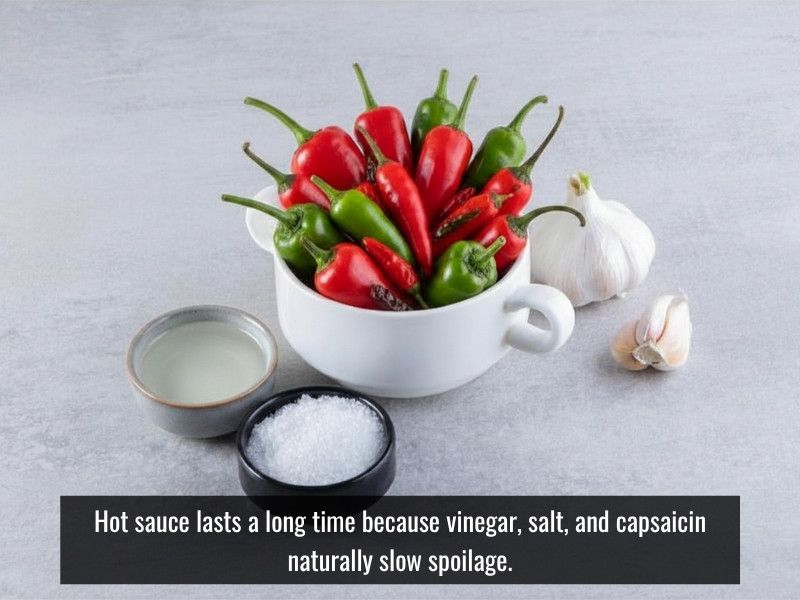
Hot sauce does expire. A typical bottle stays good anywhere from 1 to 5 years unopened, depending on the ingredients and how you store it. The expiration timeline of hot sauce is not the same as the "best by" date printed on the label. Most bottles stay safe well past the "best by" date printed on the label because vinegar, chili peppers, and salt work together as natural preservatives, slowing spoilage far longer than most condiments in your kitchen.
Still, "safe to eat" and "still tastes good" aren't the same thing. Most people toss hot sauce that's perfectly fine, or keep using sauce that's lost the flavor they paid for. The difference comes down to knowing what "expired" actually means for a vinegar-based product versus a fruit-based or dairy-based one.
In this article, CHIN-SU will help you know how long different types of hot sauce last, the signs that a sauce has gone bad, whether eating expired sauce is safe, and the storage practices that keep every bottle at its best for as long as possible.
Table Of Contents
- Does Hot Sauce Expire?
How Long Does Hot Sauce Last?
How to Tell if Hot Sauce Is Bad?
Can You Eat Expired Hot Sauce?
How to Preserve Hot Sauce as Long as Possible?
Does Hot Sauce Expire?
Yes, hot sauce expires. Almost all food spoils; different foods spoil at different rates. For most hot sauces, expiration means a loss of quality: the color darkens, the fresh pepper flavor fades, and the heat becomes more one-dimensional. It doesn't mean a safety hazard.
A bottle past its date may taste different, but it hasn't become unsafe. Hot sauce expiration works nothing like the way milk or meat spoils. Since, vinegar provides acidity that extends food shelf life without affecting quality or taste (Desai et al., 2014, Poultry Science); chili peppers contain capsaicin with documented antimicrobial and anti-virulence activity (Marini et al., 2015, Frontiers in Microbiology); and salt draws moisture out of bacterial cells through osmotic pressure.
Together, these ingredients create a high acidity environment with a pH level between 3.2 and 4.0. This is well below the FDA threshold of 4.6 for acidified foods, which is the point where foodborne pathogens such as Salmonella and E. coli can no longer survive. Unlike milk or meat, hot sauce has a built-in chemical defense system that inhibits microbial growth.
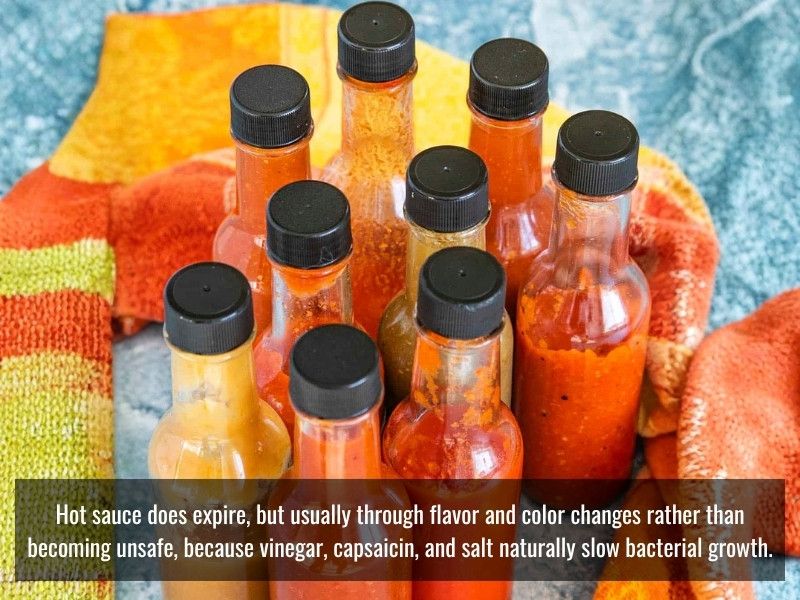
So if those ingredients protect the sauce, why does it expire at all? Preservation slows down deterioration. It doesn't stop it. Oxygen breaks down flavor compounds through oxidation, and that process runs on its own timeline regardless of the presence of bacteria.
How Long Does Hot Sauce Last?
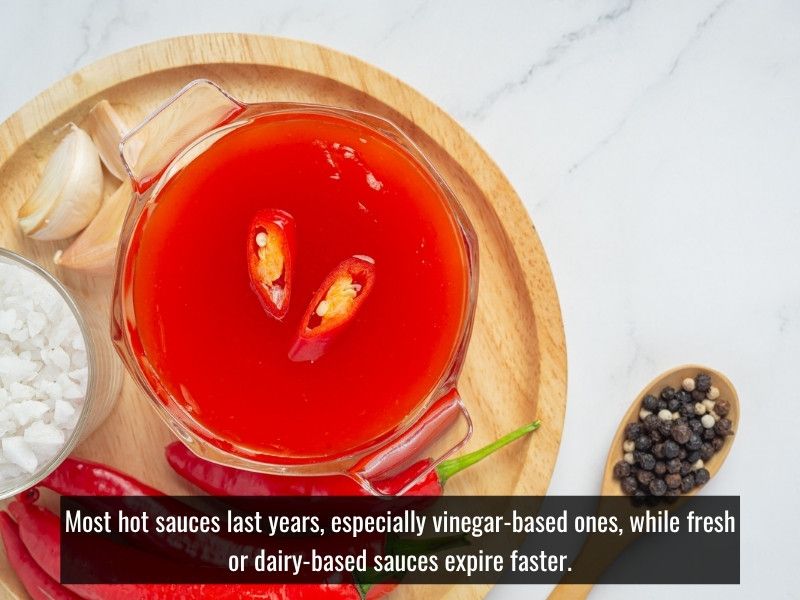
Most hot sauces last 1 to 5 years unopened and 1 month to 3 years after opening, depending on the sauce type and storage conditions. Vinegar-based sauces have the longest shelf life. Sauces made with fresh fruit, vegetables, or dairy expire the fastest.
Those numbers shift quite a bit once you break things down by sauce type and storage method. The table below shows estimated timelines for 5 common sauce types under different storage conditions.
| Sauce Type | Unopened (Pantry) | Opened (Fridge) | Opened (Room Temp) | Key Factor |
| Vinegar-based (Louisiana-style, Tabasco-style) | 3–5 years | 1–3 years | 6–12 months | High acidity, pH is typically low |
| Fermented (aged sauces, gochujang-style) | 2–3 years | 1–2 years | 6–12 months | Fermentation produces additional preserving acids |
| Chili-garlic paste / chili-oil based | 1–2 years | 3–6 months | ~1 month | Lower vinegar content, higher solids or oil content |
| Fruit-based or vegetable-forward | 1–2 years | 3–6 months | 1–2 months | Sugars and fresh produce speed up spoilage |
| Creamy / dairy-based (mayo-chili, ranch-hot sauce) | 6–12 months | 1–2 months | Not recommended | Fats oxidize; dairy components spoil |
The primary factor separating these categories is acidity. Bacteria that cause foodborne illness, including Salmonella and E. coli, cannot grow below pH 4.6 (According to the FDA's acidified foods standard (21 CFR 114). Sauces with a pH below 4.0 are shelf-safe but lose quality more quickly once opened and exposed to air. Any sauce with a pH above 4.0 or containing dairy or cream ingredients needs to be refrigerated after opening. And finally, sauces with a pH below 3.4 most effectively resist bacterial growth.
Commercial vs. Homemade Hot Sauce
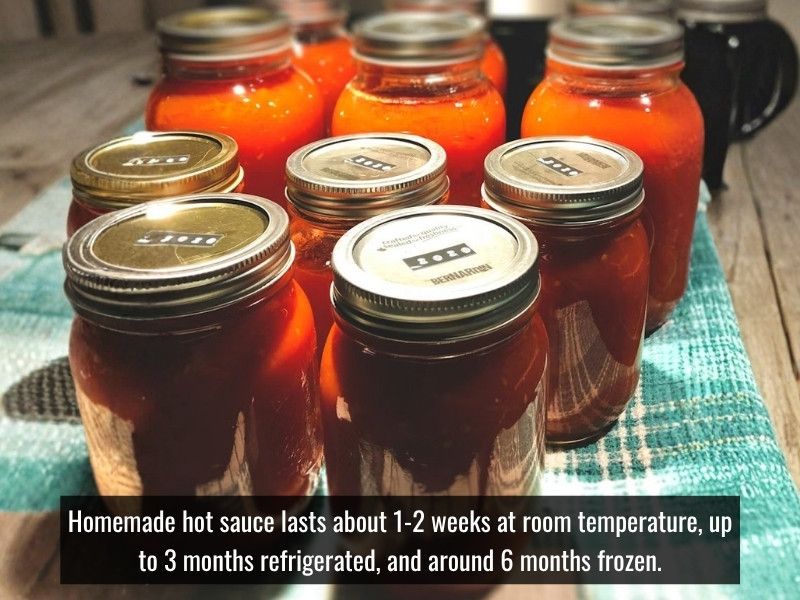
Commercial hot sauce lasts significantly longer than homemade varieties. While store bought brands can remain shelf stable for years, homemade hot sauce typically has a much shorter shelf life because it lacks industrial pasteurization and standardized preservatives. Without proper acidification, homemade sauce lasts about 1 to 2 weeks at room temperature and from 3 to 6 months in the fridge. For long term storage, you can freeze homemade sauce for up to 6 months in a freezer safe container, which helps keep the flavor profile intact even if the texture thins slightly.
Why Hot Sauce Lasts So Long?
The remarkable shelf life of hot sauce is the result of vinegar, capsaicin, and salt working in synergy. Food scientists refer to this as hurdle technology, which is a preservation framework developed by Lothar Leistner. While a single barrier like moderate acidity might not stop every pathogen, stacking multiple hurdles creates an environment that is too hostile for spoilage organisms to overcome.
This system combines the low pH environment of vinegar, the antimicrobial action of capsaicin, and the osmotic pressure created by salt. Together, these factors significantly reduce water activity, keeping a sealed bottle stable for years. Most commercial sauces contain between 100 to 200mg of sodium per serving to strengthen this microbial resistance.
Can hot sauce last forever? Not forever. Even with these strong defenses, flavor compounds break down through oxidation over time. The sauce remains safe long after its quality peaks, but it doesn't stay at its best indefinitely. Fermented sauces hold up the longest because fermentation produces additional acids during aging. Capsaicin itself is a stable molecule that doesn't break down quickly under normal storage conditions, which explains why an old bottle can still carry serious heat even when other flavors have faded.
How to Tell if Hot Sauce Is Bad?
There are 5 signs of spoiled hot sauce: mold growth, an off or rancid smell, an abnormal color change, an unusual taste, and bottle swelling or leaking. You should check them in order: sight first, then smell, then taste (only if the first two pass). A sauce that fails any single one of these checks should be discarded.
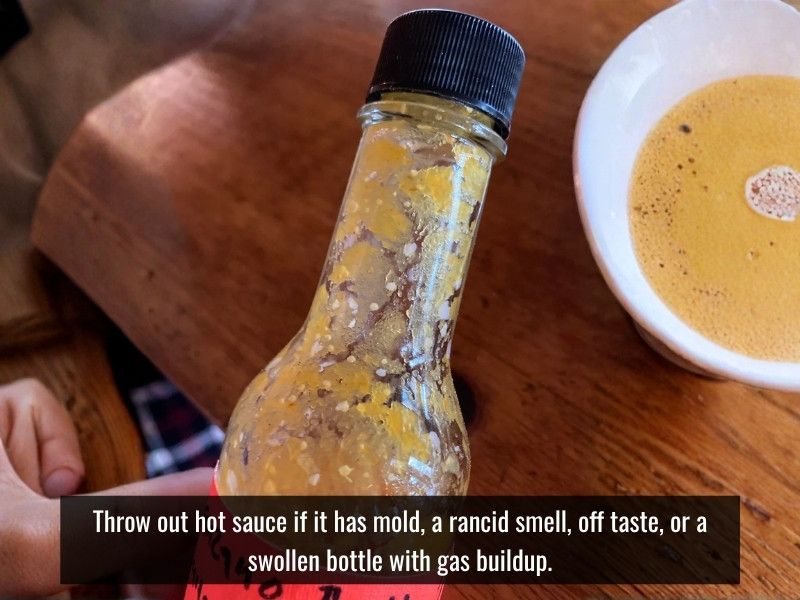
- Mold Growth. Check the bottle neck for mold spores or crusty residue. Mold can produce gas that builds internal pressure and causes the cap to pop. If you see white, black, or blue green fuzzy spots, discard the bottle.
- Rancid or Putrid Smell. A fresh hot sauce smells peppery, acidic, and sharp. A spoiled sauce smells rancid, putrid, or yeasty. If the smell makes you pull back instinctively, trust that reaction. For oil-based sauces like chili crisp or chili oil, a smell like old cooking oil or crayon wax signals fat oxidation. Discard.
- Dramatic Color Change. Gradual darkening is often normal oxidation, especially in Sriracha style sauces. However, sudden cloudiness or uneven patches of discoloration are warning signs.
- Unusual Taste: Only taste if sight and smell pass. If the sauce has a metallic bite, chemical notes, or a bitter flavor that is foreign to the original recipe, do not consume it. Normal aging can make a sauce taste less layered, more vinegary, or even hotter (because surrounding flavors faded while capsaicin held steady).
- Bottle swelling or leaking. If the bottle is bloated, the cap bulges upward, or sauce leaks from a sealed container, uncontrolled fermentation has produced gas inside. Don't open it. The pressure can cause contents to spray. Discard immediately.
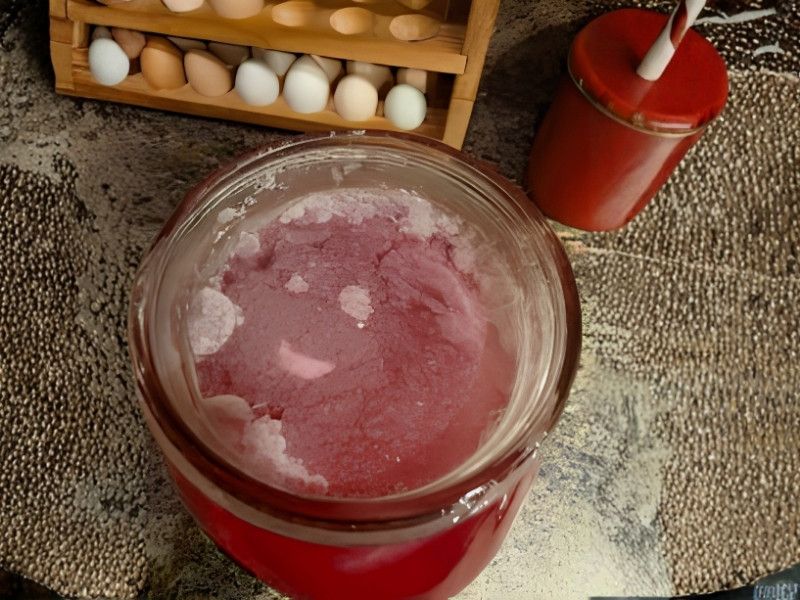
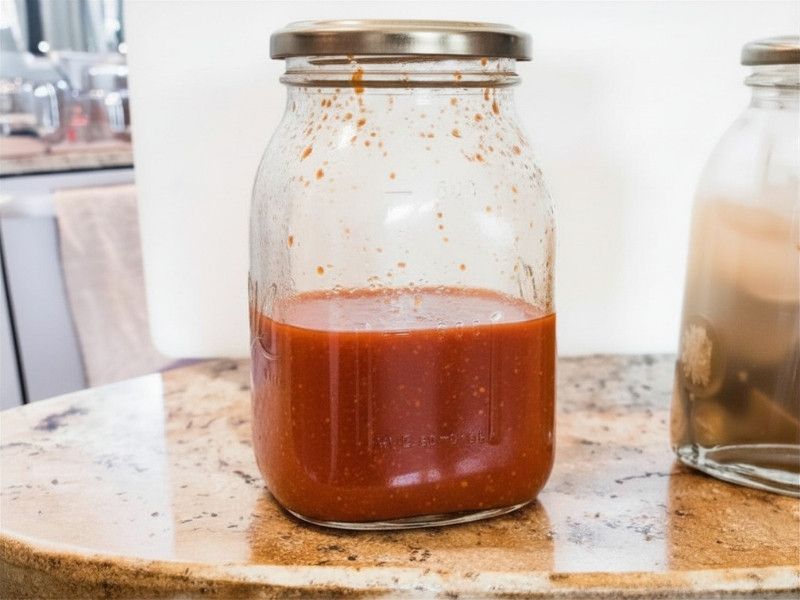
One thing worth knowing: some changes are completely normal and don't mean your sauce has spoiled. A hot sauce that's slightly darker than when you bought it hasn't gone bad. Chili peppers darken as they age, and so does garlic, which shows up in many hot sauce recipes. Normal aging changes color gradually and evenly across the whole bottle.
Is it normal for hot sauce to separate in the bottle?
Yes, absolutely. Separation is common in sauces without emulsifiers or thickeners like xanthan gum. The liquid (vinegar and water) separates from the solids (pepper particles, spices). Shake the bottle well, and the sauce should recombine. Separation alone isn't a sign of spoilage. If shaking no longer brings it back together and the solids stay compacted while the liquid looks discolored, the sauce's structure has broken down, and it's time to let it go.
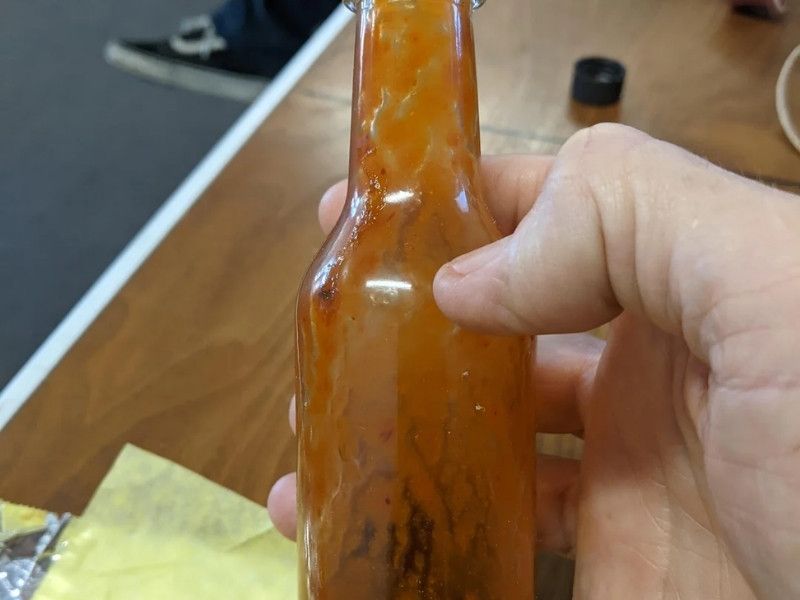
Image source: From reddit
Can You Eat Expired Hot Sauce?
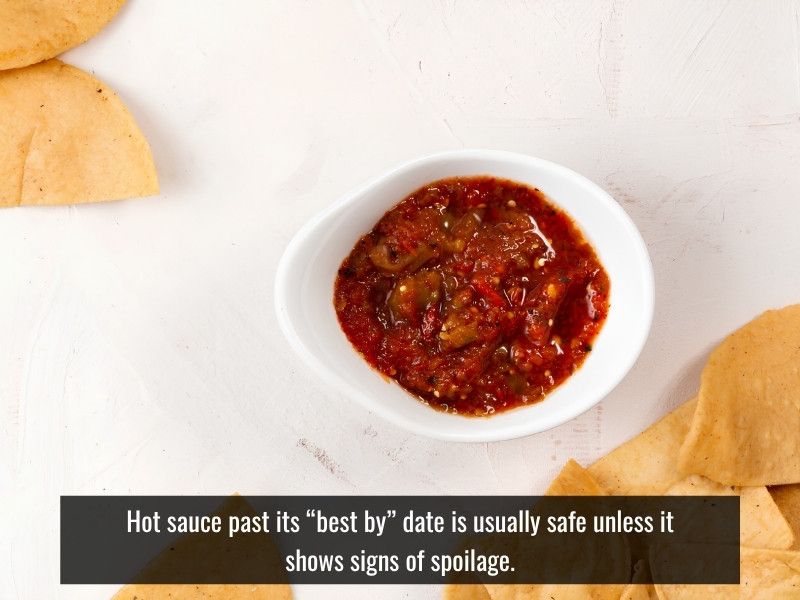
Yes, you can eat expired hot sauce, especially if it's vinegar-based, as long as it shows no signs of spoilage. The "best by" date is mainly about flavor quality, not safety. Properly stored hot sauce, even months or years past the printed date, can still be safe to consume if it passes a visual, smell, and taste check. The USDA Food Safety and Inspection Service recommends "best if used by" phrasing specifically to reduce food waste.
However, discard hot sauce if it has mold, a rancid or putrid smell, or a bad taste (metallic, chemical, or off-flavor). Do not scrape off mold and use the rest, as this won't remove possible contamination. If the bottle is swollen or the cap pops off due to gas pressure, discard it without opening.
Can Expired Hot Sauce Make You Sick?
Eating expired hot sauce is unlikely to make you sick if it's vinegar-based and shows no signs of spoilage. The primary risk comes from improperly stored sauce or from contamination, such as mold growth. Although rare in high-acid sauces, molds (like Aspergillus species) can produce aflatoxins, which the World Health Organization classifies as a Group 1 carcinogen. Symptoms from consuming spoiled sauce, such as mild stomach discomfort or nausea, are usually short-lived. Stay hydrated and contact a healthcare provider if symptoms persist beyond 24 hours.
Creamy, dairy-based hot sauces spoil faster and are riskier once expired due to their fat and dairy content. Fresh sauces without vinegar should follow their "best by" dates more strictly. Any perishable condiment left at room temperature for more than 2 hours (or 1 hour above 90°F / 32°C) should be discarded regardless of type, according to USDA food safety guidelines.
How to Preserve Hot Sauce as Long as Possible?
Now that you know how long hot sauce lasts and when to toss it, here's way how to preserve hot sauce well. These 4 practices make the biggest difference. A properly stored opened bottle lasts 2 to 3 times longer than one left on the counter next to the stove.
- Keep the bottle sealed tight. Oxygen drives color change, flavor loss, and bacterial growth. After every use, close the cap firmly. If the original cap is cracked or no longer sits flush, transfer the sauce to a clean, airtight glass container. Glass doesn't react with the sauce's acidity the way some plastics can over time.
- Store away from heat and light. Heat and light are the two biggest enemies of sauce quality. The cabinet directly above the stove is one of the worst spots in your kitchen because the stove radiates heat upward every time you cook. A lower pantry shelf, a cabinet across the room from the stove, or the fridge door is a better option. Direct sunlight through a window raises the surface temperature enough to speed up degradation, even in winter.
- Wipe the cap and neck after every use. That dried sauce residue around the bottle neck and inside the cap is a breeding ground for bacteria. It sits exposed to air and food particles every time you open the bottle. A quick wipe with a clean, damp cloth after each use prevents buildup and keeps the seal clean.
- Avoid cross-contamination. Never dip food into the bottle. Dipping chicken wings, fries, or bread directly into the bottle introduces organic matter, bacteria, and moisture. Those contaminants speed up spoilage, even in a high-acid sauce. Pour the sauce onto a plate or into a small bowl instead. If unused sauce from a plate is left over, discard it. Don't pour it back.
Does transferring hot sauce to a different container affect its shelf life? It depends on the container. Glass is the best choice because it's non-reactive and airtight. Food-grade plastic works but may absorb color and odor over time. Avoid metal containers because the sauce's acidity can react with certain metals. Whatever container you choose, make sure it's clean, dry, and seals tightly.
Does Hot Sauce Need to Be Refrigerated?
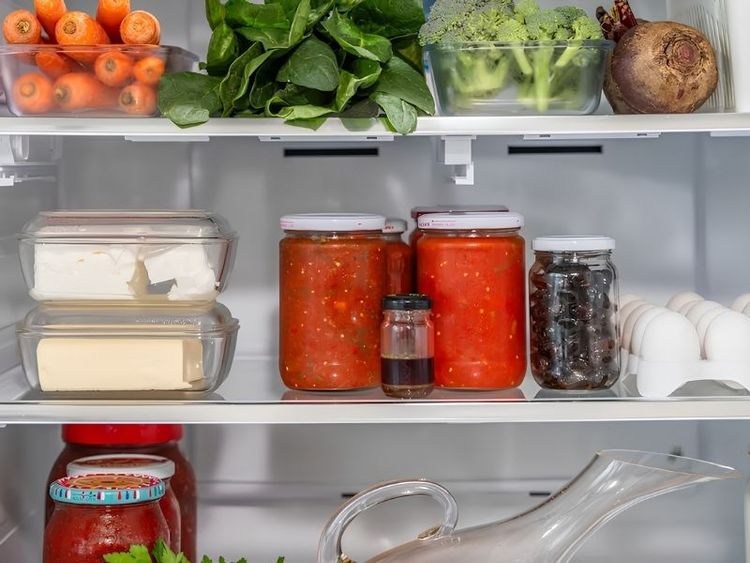
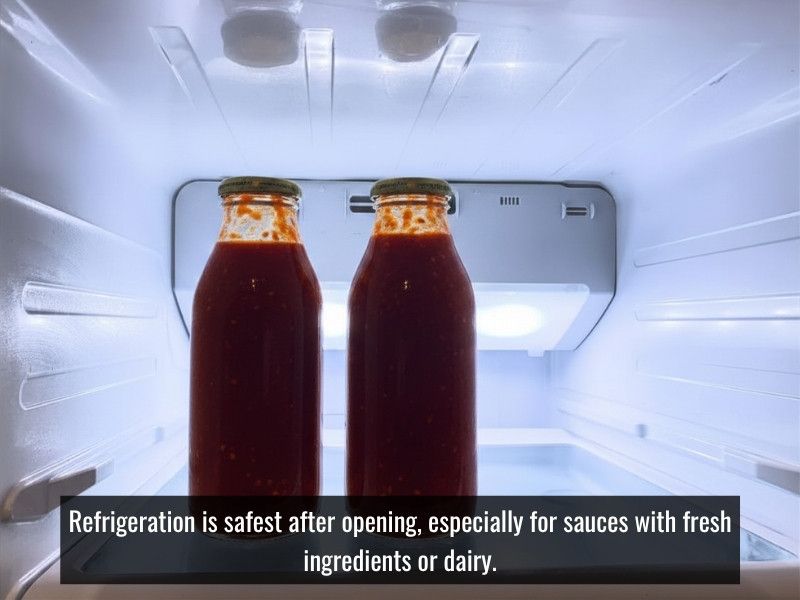
Not always, but refrigerating after opening is the safest storage practice. As mentioned above, vinegar-based sauces with no fresh ingredients can sit at room temperature for up to 12 months without spoiling. But sauces with fruit, vegetables, garlic, or dairy should always be refrigerated after opening. When in doubt, refrigerate. Cold storage never hurts.
Cold temperatures slow the 3 processes that break down your sauce: oxidation (which darkens color and fades flavor), bacterial activity (cold reduces microbial reproduction), and enzyme activity (the natural breakdown of organic compounds). The pantry-vs-fridge decision comes down to the type of sauce and how quickly you use it.
A vinegar-based sauce you'll finish within 2 to 3 months is fine in the pantry. A sauce with fruit, herbs, or dairy goes straight to the fridge. Homemade sauce gets refrigerated immediately and used within 3 to 6 months. If you're not sure, the fridge is always the safer call.
If you want to understand this in more detail, see our full guide on does hot sauce need to be refrigerated.
Check the label. Most commercial bottles include storage instructions. If it says "refrigerate after opening," follow it. If nothing is printed, the safest default is the fridge.
Why do restaurants leave hot sauce on the table all day without refrigerating it? They rotate bottles frequently, often replacing them every few days. The sauce never sits long enough for quality to drop. Home storage is different. A bottle at home might go weeks between uses, and that extended exposure to room temperature adds up.
So yes, hot sauce does expire. But with the right ingredients and storage, it's one of the last things you need to worry about in your kitchen.
If you're looking for a flavorful hot sauce with a long shelf life, consider trying CHIN-SU Hot Sauce. Made with vinegar, charcoal-grilled bird's eye chili peppers, and fermented garlic, this sauce combines bold flavor with ingredients that naturally support a longer shelf life. If you're interested, you can find CHIN-SU Hot Sauce at major retailers such as Amazon, Costco, Walmart, and 99 Ranch, or visit chinsu.com to find the nearest store.
Masan Consumer's flagship brands, including CHIN-SU, Nam Ngư, Vincafé, etc., are sold across major markets such as the United States, Japan, South Korea, and Australia. In October 2025, CHIN-SU and Nam Ngư products launched on shelves at Costco in the U.S. and South Korea, as well as Woolworths in Australia.
Frequently Asked Questions
A "best by" date marks the manufacturer's estimate of peak flavor quality. An "expiration date" suggests the product may no longer be safe. Most hot sauces carry a "best by" date, not an expiration date. The FDA doesn't require either date on shelf-stable condiments. The USDA FoodKeeper App, developed with Cornell University, is the most reliable public tool for checking food shelf life.
Yes. Without industrial pasteurization and controlled pH, homemade sauce lasts 1 to 2 weeks at room temperature and 3 to 6 months refrigerated. Use a pH meter (not test strips) and target a reading between 3.5 and 3.9 for safe, longer storage. You can freeze homemade sauce for up to 6 months in a freezer-safe container with room for expansion.
Yes, most vinegar-based hot sauces stay safe at room temperature before and after opening. An open bottle loses flavor and darkens faster than if refrigerated. Sauces with fresh fruit, vegetables, or dairy need to be refrigerated after opening. According to USDA food safety guidelines, any perishable condiment left out for more than 2 hours (or 1 hour above 90°F / 32°C) should be discarded.
The 6 factors that most shorten hot sauce shelf life are: fresh ingredients (fruit, dairy, herbs), heat exposure, light exposure, air contact (poor seal), cross-contamination (dipping food into the bottle), and low acidity (pH above 4.0). Sauces with fewer fresh ingredients, higher vinegar content, and proper storage last the longest. A bottle of vinegar-based hot sauce stored sealed in a cool, dark cabinet outlasts the same sauce left open on a sunny counter by months or even years.
Slightly. Glass is non-reactive and doesn't absorb flavors or colors. Plastic can interact with the sauce's acidity over very long storage and may take on color and odor. For long-term storage, glass is always the better choice.
Yes, it eventually loses quality, but it can remain safe for years past the printed date if kept in a cool, dark pantry. The lack of oxygen in a sealed bottle keeps the capsaicin concentration stable.
Yes, hot sauce packets from chains like Taco Bell or KFC expire faster than bottled versions. The plastic film is more permeable than glass, and the sauce often loses its consistency within 6 to 9 months. If a packet looks bloated, throw it away.

CHIN-SU KITCHEN TEAM
CHIN-SU Kitchen Team are the creative experts behind the delicious recipes featuring CHIN-SU sauces. With years of experience and a passion for flavor, our team carefully selects recipes from a variety of trusted chefs and bloggers, bringing together the best culinary insights to present you with the most suitable and exciting dishes. Every recipe is chosen to inspire you to create meals that are not only tasty but also easy to prepare, enhancing your dining experience. Join us as we explore a wide range of sauces and flavors, and elevate every meal with the perfect recipe for your table!
User Reviews
Featured Articles
Can You Have Hot Sauce on the Carnivore Diet?
Does Hot Sauce Need to Be Refrigerated?
How to Preserve Hot Sauce: 4 Methods to Try
Is Hot Sauce Gluten Free?
9 Health Benefits of Hot Sauce: Physical, Nutritional, and Metabolic
SUBSCRIBE TO GET
MORE INFO
Want the latest and greatest recipes, updates, and more from us,
straight to your inbox? Subscribe and get our NEWS!